Last updated on October 5th, 2023 at 11:36 pm
Knit Fabric Definition and Meaning
The knit fabric consists of a structure formed by inter-looping or interlocking loops of yarn. This term is used because the yarn is fed horizontally to form rows of loops that are individually locked vertically with the corresponding loop in the next horizontal row.
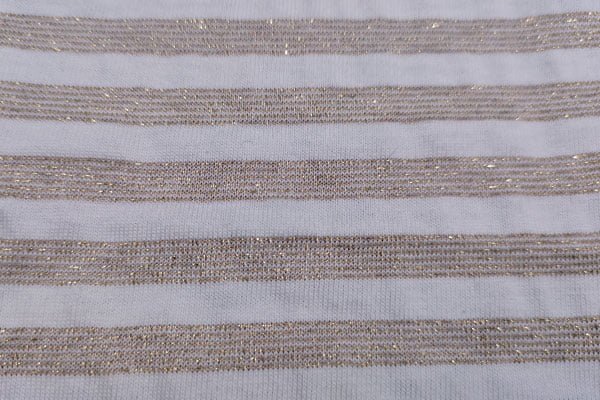
Knit fabric is more breathable and comfortable to use than woven fabrics. You can not think of your intimate wear without knitted fabrics. Where delicate touch is required, knitted fabric is used.
This type of knitting can be produced by hand using two knittings ‘needles’ and one ball of yarn. Knitting machines can produce either flat or tubular fabric according to derivatives.
It will be seen that the interlocked loops form vertical rows, which are called Wales, and horizontal rows, which are called courses. If the fabric is correctly on grain, wales and courses intersect at 900 and are thus the directional equivalent of warp and weft, as far as grain is concerned.
The stability of a simple knitted fabric is much less than that of an ordinary woven because any tension exerted on it will never be along the line of yarn but will distort the loop structure so that it can be stretched in any direction. This simple structure can also be unraveled very quickly from the top downwards. If the yarn forming a loop is broken, it immediately releases loops so that a ‘ladder’ quickly forms, widening and lengthening under tension. The instability of simple type knitted fabric was a limiting factor in their use for garments.
You may also like: The 10 best raised surface fabrics
At one time, hosiery and undergarment formed the main bulk of garments made from this type of fabric because shapes could be kept simple and the stretch of the knitted structure enabled a close fit to be obtained without complicated cutting or styling.
Knitted fabrics are now strenuously competing with woven in many clothing uses because improved machines and techniques have produced knitted fabrics in complex structures, which sometimes equal woven instability.
In addition, makers and consumers are more habituated to handling and using stretchable materials, so prejudice against knitted fabrics no longer exists to the extent it once did. Fabric lamination and bonding techniques also make knitted fabrics easier to handle by the maker and give them more stability for garment use when required.
Knitted fabric is used to make Bras, Panties, T-shirts, Polo Shirts, Hosieries, Sweaters, Cardigans, etc. It is also used as Outerwear lining.