
Why is Reactive Dye So Called?
Last updated on May 22nd, 2026 at 08:50 pm
Definition of Reactive Dye
Reactive dyes are a class of colored compounds that chemically bind to fibers like cotton, rayon, or linen to impart color resistance to washing and fading. To apply reactive dyes properly, we need a process with controlled conditions. Usually, they are used in an alkaline bath with sodium carbonate or sodium hydroxide. This high pH helps the dye react and bind with the fibers.
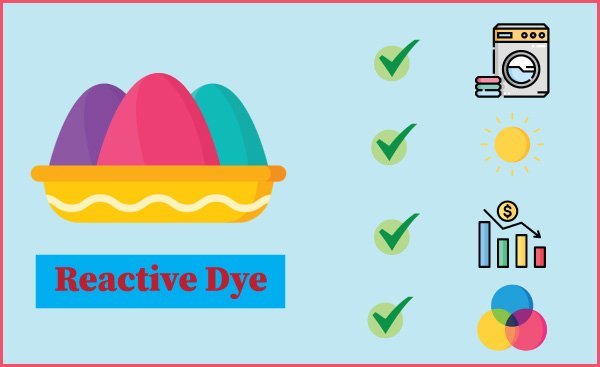
Why is it a reactive dye?
The term “reactive” signifies that the dyes react rapidly with an inert fiber like cotton and produce stable covalent bond formation with excellent color fastness. So, this dye stuff is called a reactive dye.
Significance of Reactive dye
The significance of reactive dye is given below:
- This dye stuff reacts as a reactive group that attaches with reactive parts with fiber and produces covalent bond formation.
- It is easily soluble in water.
- It can be used for coloration of cellulose and protein fiber.
- It gives a variety of color shades.
- It is used in alkali medium.
- Its color fastness properties are very good.
- Reactive dyeing process is easier.
Classification of Reactive Dye
According to chemical structure:
- Hydrogen
- Vinyl
According to Reactivity:
- High reactivity—NaHCO₃
- Moderate reactivity—Na₂CO₃
- Low reactivity – NaOH
According to using temperature:
- Cold brand: 40°C – 50°C
- Hot brand: 90°C – 95°C
Trade names of Reactive Dye
| Trade Names | Company | Country |
| Procion—m | I.C.I | U.K |
| Cibacorn | Ciba-Geigy | Switzerland |
| Reactone | Ciba-Geigy | Switzerland |
| Drimarene | Sandoz | Switzerland |
| Procilan | I.C.I | U.K |
| Procinyl | I.C.I | U.K |
These dyes are especially good at making vivid, intense colors that pop. Brand names you see in the above table. The downside is they can fade faster in sunlight than other dye types.
Reasons for Popularity
Reactive dyes are so popular due to the following reasons:
- Good washing fastness (ratings 4 – 5).
- Very good light fastness (Rating 6).
- Lower cost.
- Simple dyeing method.
- Good reproducibility.
- Low dyeing temperature (below 100°C).
- Ability to produce bright shade.
- Easily applicable to cellulosic fiber as well as protein.
- All kinds of shade are found.

Excellent…… Carry on
Good but, there is a problem in trade name….
Nice article
Such a great information. This is really very helpful for bloggers
Thanks
I ‘d mention that most of us visitors are endowed to exist in a fabulous place with very many wonderful individuals with very helpful things.