Properties of Orlon Acrylic Fabric
Last updated on April 29th, 2026 at 07:54 pm
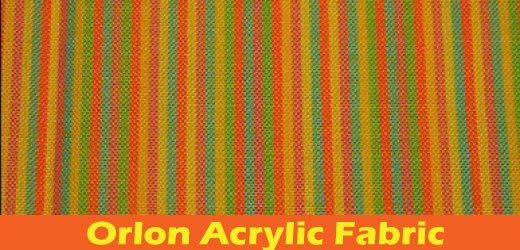
The properties of fabrics made of orlon depend on the type of fibre used as well as how the material is woven, knitted, or finished. The several types of orlon provide flexibility in application due to differences in their properties. Therefore, fabric and garment performance should be evaluated in terms of these particular characteristics as well as general properties common to all Orlon acrylic fibres.
Main Properties of Acrylic Fabric
Strength
This fibre is of moderate strength, but it is the weakest of the acrylic fibres. Compared with natural fibres, it is softer than all, except wool. Since it is used primarily as a replacement for wool, its greater strength is an advantage. The abrasion resistance of this fibre is satisfactory and compares favourably with that of wool.
Elasticity
Like the other acrylics, Orlon has a slight stretch. The low stretchability makes it useful for knitted wear since it is not likely to stretch unduly. Most of the stretch that exists is due to the mechanical crimp put into the fibre. The additional random-spiral crimp of some types of Orlon provides good extensibility without straining the fibre, thus allowing freedom of movement without developing sag.
Resilience
It has excellent resilience and, therefore, will not wrinkle easily. Fabrics of Orlon staple are not as lively in springing out from a creased position as polyester or wool, but they are still satisfactory in this respect. High resilience makes Orlon desirable for men’s slacks and suits as well as for women’s dresses.
Drapability
The drapability of this fibre varies with the type of fibre used. Generally speaking, it provides satisfactory draping qualities.
Heat Conductivity
Like all acrylics, it does not conduct heat rapidly; therefore, the fabric of this fibre can be warm. The fibre has a dog-bone cross-section, which provides overlapping and bulk with little weight. As a result, fabrics made of Orlon staple have about 20% greater insulating power per ounce (28 g) of fibre than wool fabrics. Since an ounce of this fabric is thicker than an ounce of wool, it is possible to obtain an Orlon fabric that is as wide and warm as wool but about 20% lighter. The warmth of the yarns can be increased by bulking through the use of particular types of Orlon and by blending with high-shrinkage orlon.
Absorbency
Like other acrylics, it has low absorbency. Nevertheless, fabrics made of this staple will take on quite a bit of water on account of the staple’s absorbency: the tendency of water droplets to cling to the surface of the individual fibres. Since these water droplets get into the air spaces between the fibres and evaporate slowly, Orlon’s fabrics dry slowly, although not as slow as wool fabrics.
Cleanliness and Washability
These fabrics do not contain soil or stain easily, and washing or dry cleaning quickly renews their freshness. A mild detergent should, however, be used in laundering, since strong detergents will damage them. If desired, any ordinary cleaning fluid and household bleach may be safely used.
Effect of Bleaches
Fabrics of this yarn may be safely bleached with any of the household bleaches.
Shrinkage
The discussion regarding the various types of Orlon fibre shows that some will shrink in processing. This characteristic is utilised in obtaining desired effects, such as high-bulk yarns and pile fabrics. However, once the finished product reaches the consumer, it may be expected to have excellent dimensional stability since the Orlon fibre will have practically no further shrinkage.
Effect of Heat
This fibre gets tacky at 455°F, which is slightly above that of nylon. At higher temperatures, it will melt. Fabrics from this fibre should be ironed with a moderately warm iron; in fact, they may be ironed while dry. Old creases may be removed, and new ones added. Since fabrics of this yarn may be heat-set, it is often unnecessary to press them, but some ironing may be desired to smooth the cloth.
Effect of Light
It has resistance to light. Its extreme resistance to such degradation makes it especially useful for fabrics that will be exposed to sunlight for an extended period of time.
Resistance to Mildew
Mildew may form on the surface, but it will have no effect on the fabric of this yarn. It may be easily wiped off.
Resistance to Insects
It is unaffected by moths or their larvae or by carpet beetles.
Reaction to Alkalies
It has fair to good resistance to weak alkalies and to strong alkalies at room temperature.
Reaction to Acids
It has good to excellent resistance to strong mineral acids as well as organic acids.
Affinity to Dyes
Some Orlon fibres are specific to acid dyes and some to basic dyes, which can provide interesting cross-dyed effects. Other types of orlon can be dyed in a wide range of colours and hues with cationic, disperse, naphthol, and selected vat dyes. The colours have satisfactory fastness to washing and light.
Resistance to Perspiration
All indications are that fabrics of this yarn are not readily deteriorated by perspiration, but the colour may be affected.
You may also like:
1. Properties of Jute Fibre
2. Properties of Acrylic Fibre
3. Properties of Nylon