Last updated on November 27th, 2026 at 09:08 pm
Fabric changes size after washing. Use this calculator to find warp and weft shrinkage, area shrinkage and the right cut size. Enter your before and after measurements, then press Calculate.
What is Fabric Shrinkage?
Fabric shrinkage is the loss in size after a fabric is washed or dried. Yarns are pulled tight during weaving, knitting and finishing. Water and heat let them relax. The fabric gets smaller.
Cotton, viscose and linen shrink the most. Polyester shrinks very little. Even a small change matters in garment making. One percent on a shirt body can ruin the fit across thousands of pieces.
Want to learn the test method first? Read How to Calculate Shrinkage in Fabric. Then use the calculator above for the maths.
Warp and Weft Shrinkage
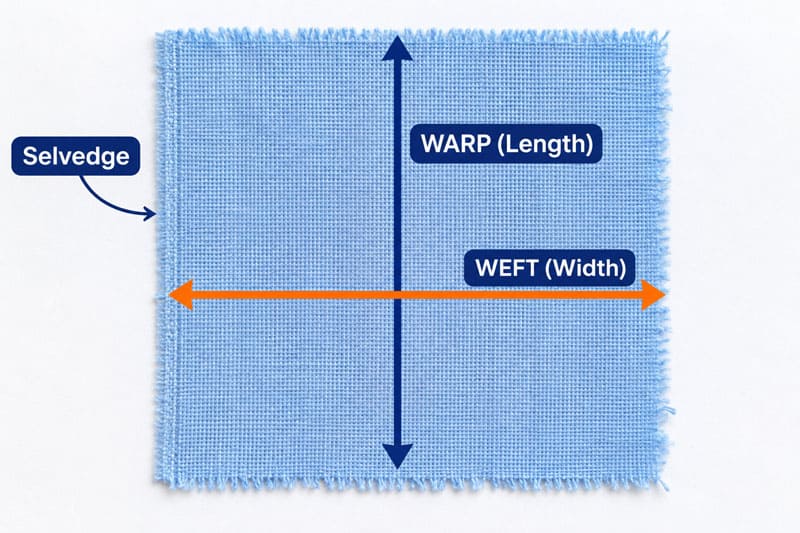
Woven fabric has two directions. Warp runs along the length. Weft runs across the width. Each direction can shrink by a different amount.
Why the two values differ
Warp yarns carry more tension on the loom. They often shrink more when they relax. Weft yarns usually shrink less. Finishing changes both values too. So never copy one value to the other direction. Measure both.
How to Use the Fabric Shrinkage Calculator
- Choose your unit: centimeters, millimeters or inches.
- Enter the length and width of the swatch before wash.
- Wash and dry the swatch the way your buyer asks. Let it rest flat.
- Measure again and enter the length and width after wash.
- Add a finished length and width if you want the cut size. Leave them empty if you do not.
- Press Calculate. Use Copy Result or Share Result to send the numbers.
Every measurement must be greater than zero. Finished sizes are optional. If you fill one, it must also be greater than zero.
The Shrinkage Formula
The formula is simple.
A positive answer means shrinkage. A negative answer means growth. Zero means no change. Use the same formula for length and width.
The unit does not matter. Centimeters and inches give the same percentage, as long as before and after use the same unit.
Worked Examples
Example 1: Length and width
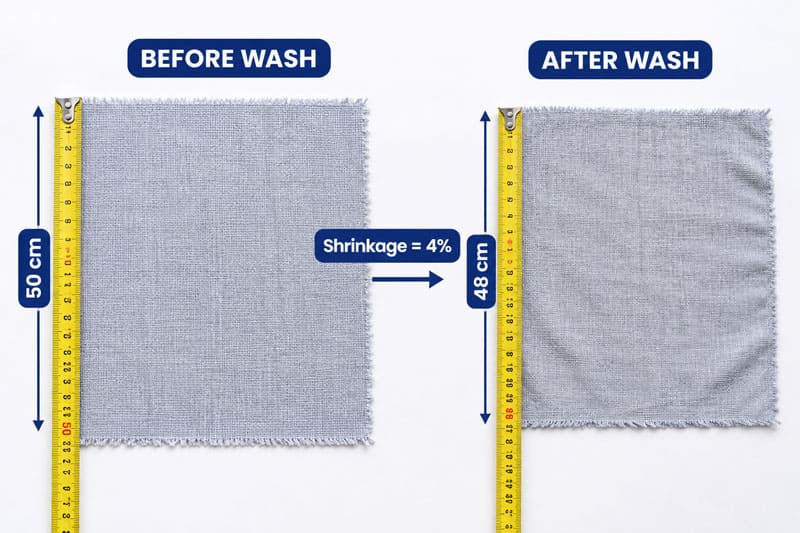
Length goes from 50 cm to 48 cm. Width goes from 50 cm to 49 cm. Length shrinkage is (50 − 48) ÷ 50 × 100 = 4.00%. Width shrinkage is (50 − 49) ÷ 50 × 100 = 2.00%. Area shrinkage is 5.92%. For a 100 cm finished size, cut length is 104.17 cm and cut width is 102.04 cm.
Example 2: Longer fabric piece
Length goes from 100 cm to 96.5 cm. Width goes from 100 cm to 98 cm. Length shrinkage is 3.50%. Width shrinkage is 2.00%. Area shrinkage is 5.43%.
Example 3: Growth
Length goes from 50 cm to 52 cm. That is 4.00% growth. To get 100 cm finished, cut 96.15 cm.
| Example | Measurements | Result |
|---|---|---|
| 1 | Length 50 to 48 cm, width 50 to 49 cm | 4.00% and 2.00%, area 5.92%. Cut 104.17 cm by 102.04 cm. |
| 2 | Length 100 to 96.5 cm, width 100 to 98 cm | 3.50% and 2.00%, area 5.43%. |
| 3 | Length 50 to 52 cm | 4.00% growth. Cut 96.15 cm. |
Area Shrinkage
Fabric shrinks in two directions at once. So the area shrinks by more than either single value.
Before area is before length × before width. After area is after length × after width. In Example 1, the area goes from 2,500 cm² to 2,352 cm². That is a loss of 5.92%.
Area shrinkage helps with costing. It shows how much usable fabric you lose after wash.
How Much Extra to Cut
Many people add the shrinkage percent to the size. That is not exact. The fabric shrinks from the bigger cut size, not from the finished size. So you must divide.
Take a 100 cm finished length with 4.00% shrinkage. Cut size is 100 × 50 ÷ 48 = 104.17 cm. Adding 4% gives only 104 cm. The gap looks small, but it adds up on a large order. Do the same for width. Add seam allowance after that.
Shrinkage also changes the weight of the fabric per square metre. Check the new weight with the GSM Calculator.
Shrinkage vs Growth
Not every fabric shrinks. Some fabrics grow. Loose knits and stretchy fabrics can get longer after wash. Fabric under tension in finishing can also relax and grow.
The calculator shows a negative result as Growth. The word sits beside the number. Zero shows No change. Results are rounded to two decimals, so a tiny change can show as No change.
For growth, the cut size is smaller than the finished size. In Example 3, you cut 96.15 cm to get 100 cm.
Common Mistakes
- Measuring a stretched swatch. Lay it flat and let it relax first.
- Using a very small swatch. A bigger swatch gives a better result.
- Measuring too close to the selvedge or the cut edge.
- Mixing units, such as before in centimeters and after in inches.
- Using a wash that differs from the buyer’s test.
- Adding the percent instead of dividing for the cut size.
- Ignoring colour change. A washed fabric may fade too. Check it with the Delta E Calculator.