It covers all three formulas labs use, because a ΔE of 1.0 under one formula is not the same test as 1.0 under another. Enter your standard and sample colours, choose a formula, then press Calculate.
What is Delta E?
Delta E (ΔE) is one number for colour difference. It compares two colours. One is your standard. The other is your sample. A small number means a close match. A large number means a visible gap.
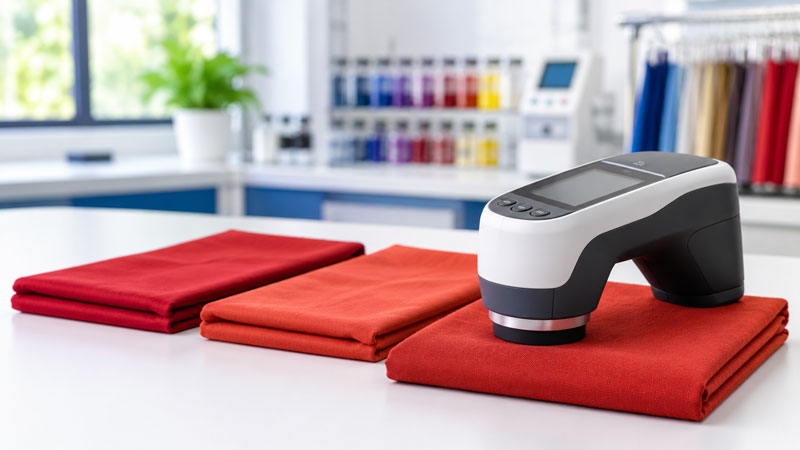
Textile teams use it every day. A dyer checks a lab dip against the approved shade. A QC team checks a bulk lot against the standard. The number turns opinion into a record.
Colours are measured in CIELAB space. L* is lightness. a* runs from green to red. b* runs from blue to yellow. A spectrophotometer gives you these readings. This calculator assumes D65 daylight values.
How to Use the Delta E Calculator
- Pick the input format. CIELAB is the default. LCh and sRGB also work.
- Enter the standard colour values.
- Enter the sample colour values.
- Choose a formula. CIEDE2000 is the default.
- Set your tolerance. 1.0 is a common limit.
- Press Calculate.
L* must be 0 to 100. a* and b* must be between −128 and +128. Tolerance must be above 0. In sRGB mode, R, G and B must be 0 to 255. The page scrolls to your result when it is ready.
You get ΔE for all three formulas. The selected formula is the headline. You also get ΔL*, Δa*, Δb* and ΔC*. Then comes the verdict and a perception note. Use Copy Result or Share Result to pass it on.
Checking fabric faults as well? Try the Fabric Quality Inspection Calculator: 4-Point System. Planning lot sampling? Use the AQL Calculator.
The Formula
Each formula answers a slightly different question. Always name the formula when you report a ΔE.
CIE76
This is the oldest and simplest formula. It is the straight-line distance between two points in CIELAB space.
ΔE*ab = √(ΔL*² + Δa*² + Δb*²)
It is easy to check by hand. But it treats every direction the same. The human eye does not.
CMC (2:1)
This one was built for textiles. ISO 105-J03 describes it. Lightness is weighted half as much as chroma and hue. That matches how buyers judge fabric.
The 2:1 ratio is the acceptability setting. The formula also adapts to the standard’s lightness, chroma and hue. So the same gap counts differently in different parts of colour space.
CIEDE2000
This is the current ISO/CIE standard. It is the most accurate of the three. It corrects for lightness, chroma and hue. It also fixes problems in the blue region and near grey. That is why it is the default here.
Worked Example
Standard: L* 50, a* 25, b* 10. Sample: L* 51, a* 24, b* 12. Tolerance: 1.0.
Example 1: FAIL
- ΔL* +1.00 (sample lighter)
- Δa* −1.00 (sample less red)
- Δb* +2.00 (sample more yellow)
- ΔC* −0.09 (sample slightly duller)
- ΔE: CIE76 2.45, CMC (2:1) 2.07, CIEDE2000 1.90
All three are over the 1.0 tolerance. The verdict is FAIL. At 1.90, the difference is perceptible on close observation.
The three formulas give different numbers for the same pair. That is why the result must name the formula.
Example 2: PASS
Same standard. Sample: L* 50.4, a* 24.7, b* 10.3. The results are CIE76 0.58, CMC (2:1) 0.41 and CIEDE2000 0.50. That is a PASS at tolerance 1.0.
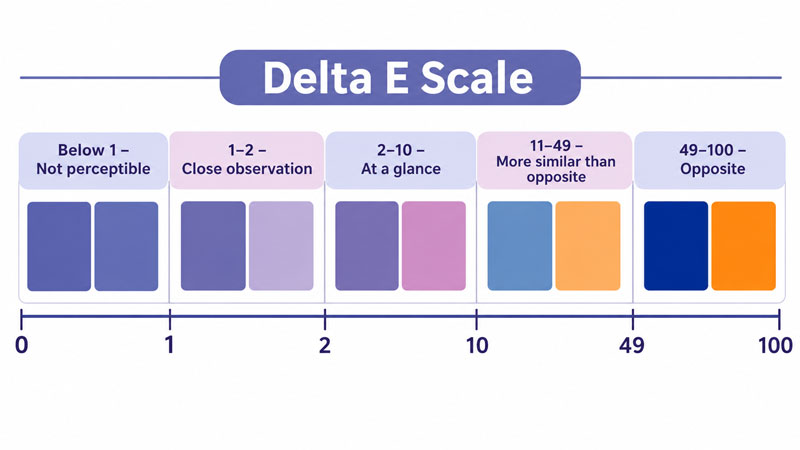
What the Number Means
- Below 1: not perceptible.
- 1 to 2: perceptible on close observation.
- 2 to 10: perceptible at a glance.
- 11 to 49: colours are more similar than opposite.
- 49 to 100: colours are opposite.
These bands describe human perception. They do not describe your buyer’s limit. A pass or fail always needs a tolerance.
What Tolerance Should You Use?
Start with the buyer’s specification. It always comes first. Many buyers give a ΔE limit and name the formula. Some set separate limits for lightness, chroma and hue. Follow them exactly.
There is no single universal limit. But 1.0 is the common one. It is a sensible starting point when the spec is silent.
Tighter limits, such as 0.5, suit critical matches. Think of garments sold as sets. Looser limits suit dark shades, which hide differences better.
Record three things with every result: the formula, the tolerance and the light source. Without all three, a pass means little. Agree the method with your buyer before production starts.
CIE76 vs CMC vs CIEDE2000
- CIE76: simple and old. Use it only when a legacy spec asks for it.
- CMC (2:1): the textile favourite. Many buyers still name it.
- CIEDE2000: the most accurate. Use it when no formula is specified.
The rule is easy. Use the formula your buyer names. If none is named, use CIEDE2000.
FAQs
The grey scale is a visual rating from 1 to 5. A person judges it. Delta E is an instrument reading. It is more repeatable. The two do not convert exactly.
ΔE shows distance, not direction. A sample can be lighter, redder or duller and still give the same number. Check ΔL*, Δa* and Δb* too.
Two colours can match under one light and differ under another. Dyes reflect light in different ways. A single D65 reading cannot show this. Check the pair under a second light.
You also like T-Shirt Printing Cost Calculator