Last updated on November 26th, 2026 at 09:32 am
Estimate how much fabric your air jet loom weaves. Enter the loom speed, efficiency and picks density. Add the reed width if you want area production. Choose your units, then press Calculate.
What is Air Jet Loom Production?
Air jet loom production is the amount of fabric a loom weaves in a set time. Mills usually measure it in metres or yards per hour. They also track it per shift and per day.
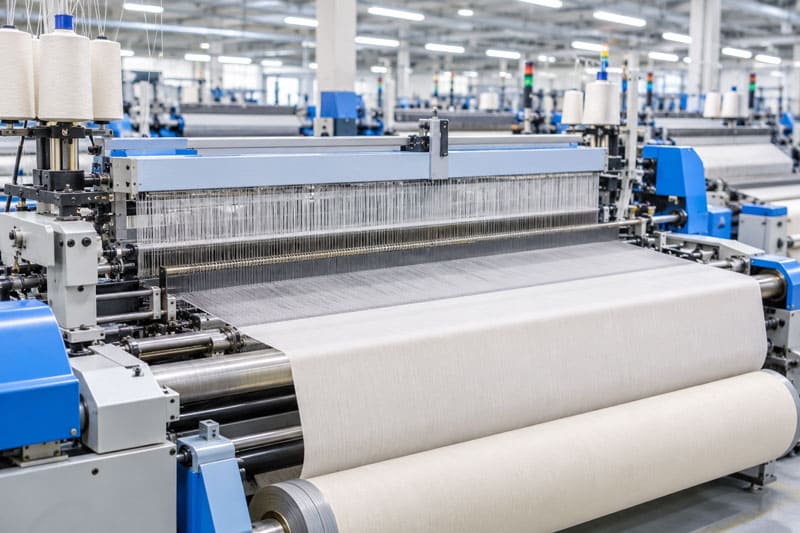
An air jet loom inserts the weft yarn with a burst of compressed air. This makes it very fast. A modern machine can run at 600 RPM or more. But speed alone does not tell the full story. Stops, breaks and waiting time cut the real output.
That is why this calculator uses efficiency. It turns the rated speed into a realistic figure. You can plan orders, check targets and compare looms with it.
How to Use the Calculator
Using the tool takes a few seconds. Follow these steps.
- Enter the loom speed in RPM.
- Enter the efficiency as a percentage.
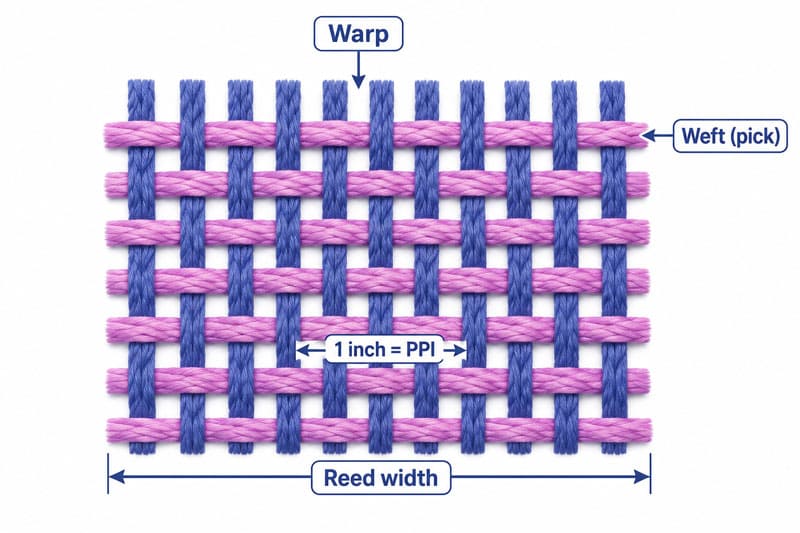
- Enter the picks density. Choose picks per inch or picks per cm.
- Add the reed width only if you want area production.
- Pick your result units, then press Calculate.
The results appear below the buttons. Use Copy Result to save them. Use Share Result to send them to a colleague. Press Reset to start again.
The Formula
The calculation has a few simple steps. Each one feeds the next.
Length production
- Actual picks per hour = RPM × 60 × Efficiency ÷ 100
- Inches per hour = Actual picks per hour ÷ PPI
- Yards per hour = Inches per hour ÷ 36
- Metres per hour = Inches per hour × 0.0254
- Per 8-hour shift = hourly output × 8
- Per 24 hours = hourly output × 24
Area production
- m² per hour = Metres per hour × Reed width (in) × 0.0254
- Sq yd per hour = Yards per hour × Reed width (in) ÷ 36
If you use picks per cm, the tool multiplies by 2.54 to get PPI. Other reed width units are converted to inches first.
Worked Example
Take a loom at 600 RPM and 90% efficiency. The fabric has 60 PPI and a reed width of 100 inches.
- Actual picks: 600 × 60 × 90 ÷ 100 = 32,400 per hour
- Inches per hour: 32,400 ÷ 60 = 540
- Yards per hour: 540 ÷ 36 = 15.00
- Metres per hour: 540 × 0.0254 = 13.72
- Per 8-hour shift: 120.00 yards or 109.73 metres
- Per 24 hours: 360.00 yards or 329.18 metres
- Area: 34.84 m² per hour, or 41.67 sq yd per hour
You can type these numbers into the calculator to check it.
Length Production vs Area Production
These two measures answer different questions.
Length production
This tells you how many metres or yards leave the loom. Most sales contracts use it. Weavers and buyers talk in running length.
Area production
This adds the fabric width. It gives square metres or square yards. It is useful when you compare looms with different widths. It also helps when you cost by area or by weight.
Which one should you use?
Use length for daily targets. Use area to compare machines or fabrics of different width.
What Affects Loom Production
Many factors change the real output. Some you can control. Some you cannot.
Machine and yarn
Yarn quality matters most. Weak or uneven yarn breaks often. Each break stops the loom. Air pressure and nozzle condition also play a part.
Fabric design
Higher PPI means slower length output. The loom must insert more picks for each inch. Complex weaves can also slow the machine.
Preparation and people
Good warping and sizing reduce warp breaks. Skilled weavers and fitters cut idle time. Planned maintenance prevents big stoppages.
Environment
Humidity and dust affect yarn behaviour. A stable weaving shed gives steadier results.
Common Mistakes
- Using 100% efficiency. No mill reaches it. Use your real figure.
- Mixing units. Do not enter picks per cm as PPI.
- Typing efficiency as a decimal. Enter 90, not 0.9.
- Using the wrong reed width. Use the width in the reed, not the finished fabric.
- Ignoring shrinkage. Greige length and finished length differ.
- Forgetting planned stops such as beam changes and doffing.
Also check your related numbers. Use the EPI/PPI & Cover Factor Calculator to verify fabric density. Then estimate yarn needs with the Warp Yarn Requirement Calculator and the Weft Yarn Requirement Calculator. Finish with the Fabric Costing Calculator to price your order.
FAQs
What efficiency should I use?
Use your mill’s recent average. Many air jet mills run between 85% and 95%.
Does this work for other looms?
Yes. The same formula works for any loom with one pick per revolution.
Why does higher PPI lower the output?
More picks are needed for each inch of fabric. So fewer inches are made per hour.
Is reed width required?
No. It is only needed for area results. Length results work without it.
Is the result exact?
It is an estimate. Real output changes with stops, yarn quality and shrinkage.
Can I use metric units?
Yes. Choose picks per cm and a metric reed width. Results can show metres and m².