
Last updated on November 27th, 2026 at 09:55 am
Enter the length and weight of a yarn sample. The calculator shows Ne, Nm, Tex and Denier together, so you can compare every system at once. Need to switch systems by hand? Try our Yarn Count Conversion Calculator.
What is Yarn Count?
Yarn count tells you how thick or thin a yarn is. It links the length of a yarn to its weight. A fine yarn has little weight for its length. A coarse yarn has more.
Spinners, weavers and knitters use yarn count every day. It decides fabric weight, handle, strength and price. A wrong count can ruin a whole order.
Different regions use different systems. Cotton mills often use Ne. Wool and many European mills use Nm. Filament and synthetic yarns use Denier or Tex. This calculator gives all four from one sample.
How to Use the Calculator
- Enter the sample length and choose Metres or Yards.
- Enter the sample weight and choose Grams, Kilograms or Pounds.
- Or pick a preset such as the 120 yd lea, 840 yd hank or 1000 m skein. It fills the length for you.
- Press Calculate.
- Read Ne, Nm, Tex and Denier, plus your sample in metres and grams.
Both values must be greater than zero. Use Copy Result to save the numbers, or Share Result to send them on.
Yarn Count Formulas
The calculator first converts your sample to metres and grams. Then it applies these steps.
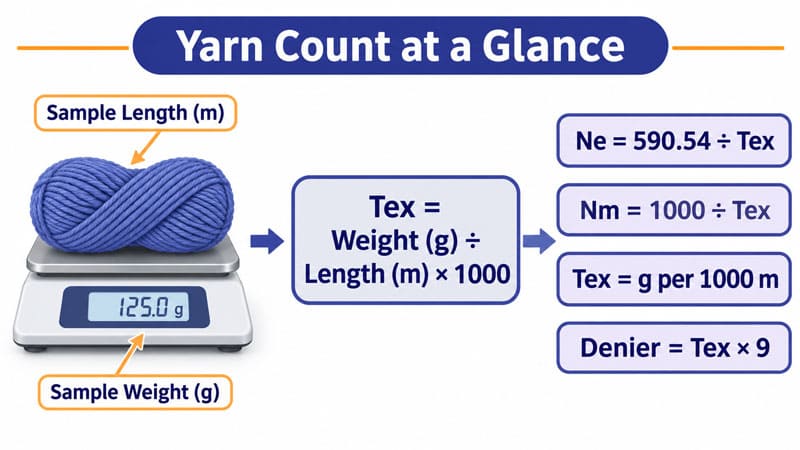
- Length in metres = yards × 0.9144
- Weight in grams = kilograms × 1000, or pounds × 453.59237
- Tex = weight (g) ÷ length (m) × 1000
- Denier = Tex × 9
- Ne = 590.54 ÷ Tex
- Nm = 1000 ÷ Tex
Why Tex comes first
Tex is a clean base unit. Every other count is a simple step away from it. To turn one count into another without a sample, use the Yarn Count Conversion Calculator.
Worked Examples
Example 1: 8400 yards and 1 pound
8400 yards is 7680.96 m. One pound is 453.59 g. Tex is 59.05. Ne comes out at exactly 10.00.
Example 2: 1000 m and 20 g
Tex is 20 ÷ 1000 × 1000, so 20.00. Denier is 180.00. Ne is 29.53 and Nm is 50.00.
Example 3: 9000 m and 150 g
This is the classic denier test length. Denier is 150.00. Tex is 16.67, Ne is 35.43 and Nm is 60.00.
| Sample | Ne | Nm | Tex | Denier |
|---|---|---|---|---|
| 8400 yd, 1 lb | 10.00 | 16.93 | 59.05 | 531.49 |
| 1000 m, 20 g | 29.53 | 50.00 | 20.00 | 180.00 |
| 9000 m, 150 g | 35.43 | 60.00 | 16.67 | 150.00 |
Direct vs Indirect Systems
Direct systems
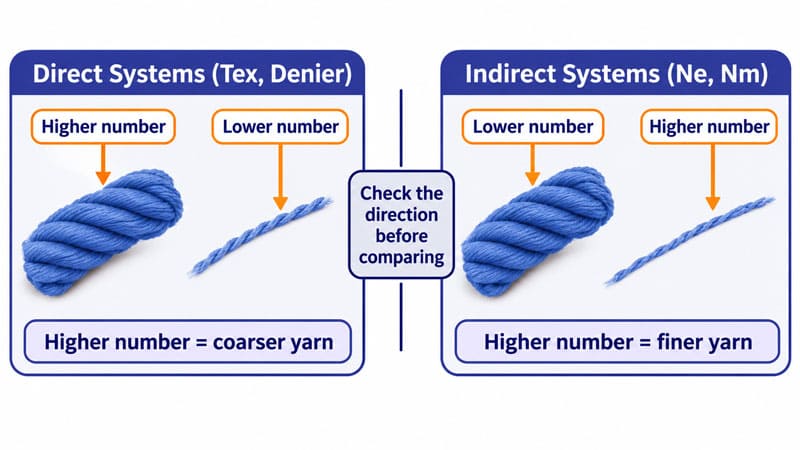
Tex and Denier are direct. They give the weight of a fixed length. A bigger number means a heavier, coarser yarn.
Indirect systems
Ne and Nm are indirect. They give the length of a fixed weight. A bigger number means a finer yarn.
This is why Ne 40 is finer than Ne 20, while Tex 40 is coarser than Tex 20. Mixing up the direction is a very common error. Always check which way the scale runs before you compare two yarns.
Skein Lengths Used in Testing
Labs wind a standard length of yarn, then weigh it. The three presets here cover the most common tests.
- 120 yd lea: a small skein used for quick cotton checks. Seven leas make one hank.
- 840 yd hank: the base length of the English cotton count. One hank weighing one pound is Ne 1.
- 1000 m skein: a handy length for metric work and for Nm.
Denier tests often use 9000 m, which is why you can also enter that length directly. Longer samples usually give steadier results, because small weighing errors matter less.
Common Mistakes
- Mixing units. Yards and metres, or pounds and grams, give very different answers. Always check the unit boxes.
- Weighing a damp sample. Moisture adds weight and lowers the count. Condition the yarn first.
- Using a stretched sample. Pulling the yarn while winding changes its length.
- Reading Ne like Tex. Remember that one is indirect and the other is direct.
- Using too short a sample. A tiny sample makes small errors look big.
Counts feed many other tasks. For fabric planning, see the EPI/PPI & Cover Factor Calculator and the Warp and Weft Yarn Requirement Calculators. For knits, use the Knit Fabric GSM Calculator.
FAQs
None is best. Use the system your buyer or mill uses. This tool shows all four.
Finer. Ne is an indirect system, so a higher number means a thinner yarn.
Tex is direct. It measures weight per fixed length, so more weight means a bigger number.
Yes. The calculator scales the result to the standard length of each system.
Divide 590.54 by Ne to get Tex, then multiply by 9. Or use the conversion calculator.