Work out fabric GSM in seconds. Weigh a sample, or enter EPI, PPI and yarn count. You get GSM and oz/yd² instantly. Pick a method, fill in the fields and press Calculate.
What is GSM?
GSM means grams per square metre. It tells you how heavy a fabric is. A higher GSM means a thicker, heavier cloth. A lower GSM means a light, airy one.
Mills, buyers and designers all use it. It affects price, drape and feel. It also decides what a fabric suits. A 90 GSM chiffon floats. A 350 GSM canvas holds its shape.
Two fabrics can look alike and still differ by 50 GSM. That gap changes cost and comfort. So check GSM before you order. Check it again when the goods arrive.
How to Use the Calculator
Pick a method first. Then fill in the fields and press Calculate. Use the unit dropdowns if your data is in other units.
Method 1: The cutter method
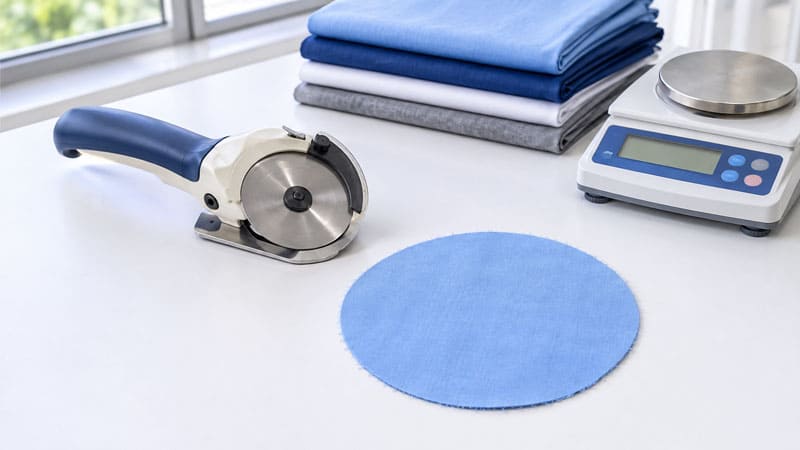
This is the standard lab method. It follows BS EN 12127. Use it whenever you have a physical sample.
- Condition the fabric. Leave it flat in a standard atmosphere until it dries and settles.
- Lay the fabric flat. Remove wrinkles without stretching it.
- Cut a 100 cm² circle with a round GSM cutter. Stay away from the selvedge and from creases.
- Weigh the circle on a precision balance. Record the weight in grams.
- Enter the weight. Keep the cutter size on 100 cm².
- Press Calculate. Read the GSM.
No cutter? Choose 10 cm × 10 cm. Or choose Custom size and enter your own length and width.
Method 2: Woven fabric
Use this when you have a construction but no sample. Enter EPI and PPI. Enter the warp and weft counts. Pick the count unit: Ne, Tex, Nm or Denier. Add a crimp allowance if you want a closer match to real cloth.
The Formula
Sample method
With the 100 cm² cutter, the area is 0.01 m². So the shortcut is simple:
Woven method
Warp GSM = EPI × tex ÷ 25.4
Weft GSM = PPI × tex ÷ 25.4
Total GSM = (Warp GSM + Weft GSM) × (1 + crimp ÷ 100)
There is also an Ne shortcut:
Converting to ounces
Worked Example
Example 1: Cutter sample
A 100 cm² cutter sample weighs 2.5 g. So GSM = 2.5 × 100 = 250 GSM. In ounces, that is 7.37 oz/yd².
Example 2: Custom size
A sample measures 20 × 25 cm. That is 500 cm², or 0.05 m². It weighs 10 g. So GSM = 10 ÷ 0.05 = 200 GSM. That is 5.90 oz/yd².
Example 3: Woven fabric
Take 100 EPI × 60 PPI, with 40s Ne in both directions. Tex = 590.541 ÷ 40 = 14.76. Warp GSM is 58.12. Weft GSM is 34.87. The total is 93.00 GSM, or 2.74 oz/yd². This is the same fabric we used in the cover factor example.
Adding crimp
Now try 60 EPI × 56 PPI, again 40s/40s. The base result is 67.42 GSM. Add 5% crimp and it becomes 70.80 GSM. That is 2.09 oz/yd².
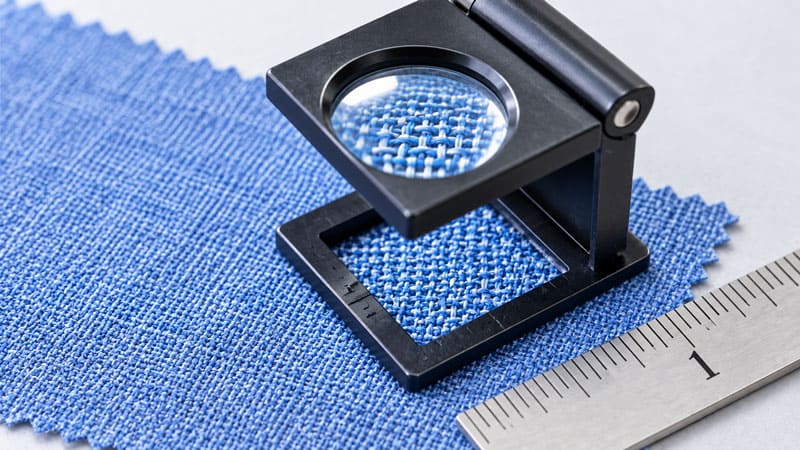
GSM Ranges for Common Fabrics
Use this table as a rough guide. Real fabrics vary by fibre, weave and finish.
| Fabric | Typical GSM | Class |
|---|---|---|
| Chiffon | 50–100 | Lightweight |
| Poplin / shirting | 100–200 | Light to medium |
| T-shirt jersey | 150–200 | Medium |
| Denim | 250–400 | Medium to heavy |
| Canvas | 300+ | Heavy |
The calculator uses three simple bands. Under 150 GSM is lightweight. From 150 to 300 is medium. Over 300 is heavy.
GSM vs Ounce
GSM is the metric unit. Ounce per square yard is common in the US and UK, mostly for denim and canvas. One oz/yd² equals about 33.9 GSM.
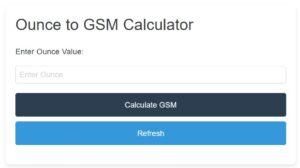
So a 12 oz denim is roughly 407 GSM. An 8 oz canvas is about 271 GSM. Use the GSM to Ounce tool for quick conversions. Go the other way with Ounce to GSM.
Common Mistakes
Four errors that spoil results
A damp sample
Moisture adds weight. Your GSM will read too high. Condition the sample first.
The wrong area
A badly cut sample gives a wrong area. Use a sharp cutter. Measure custom sizes carefully.
Forgetting crimp
Yarn bends as it weaves. So real fabric holds more yarn than the flat formula shows. Add a crimp allowance for a closer match.
Mixing cm and inches
Pick the right unit in the dropdown. A mix-up can change the answer a lot. EPI and PPI are per inch. EPC and PPC are per cm.
FAQs
What is a good GSM for a T-shirt?
Most T-shirts sit between 150 and 200 GSM.
Is a higher GSM always better?
No. It depends on the use. Heavy is good for jackets. Light is good for summer shirts.
What size cutter should I use?
Use a 100 cm² round cutter. It is the standard size, and the math is easy.
Why does my woven GSM differ from the measured one?
Finishing, sizing, shrinkage and crimp all change the weight. Add a crimp allowance to get closer.
How do I convert GSM to oz/yd²?
Multiply GSM by 0.0294935.
Can I use this for knit fabric?
Yes, the sample method works for knits. For knit construction, try the Knit Fabric GSM Calculator.