
Estimate your fabric output in seconds. Enter your machine setup, yarn and shift details. Get hourly, shift and daily production in kg, lb or g.
Key Inputs Needed for Accurate Production Calculation
Good numbers in, good numbers out. Each input below changes your result. Measure them on the floor, not from the catalog.
Machine Setup Inputs
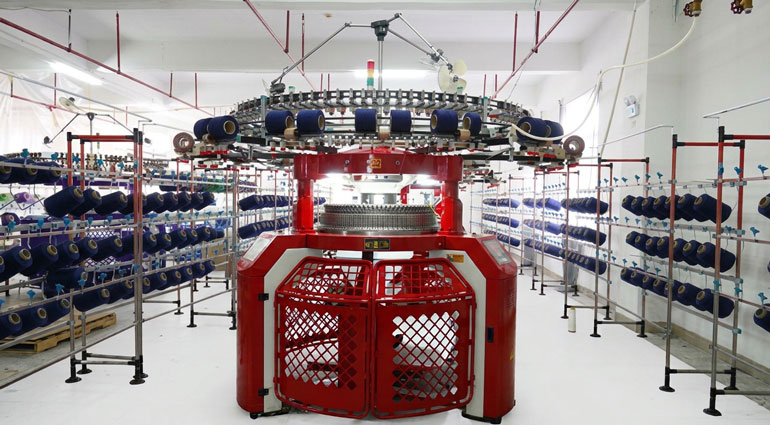
Diameter and gauge decide the total needle count. More needles mean more stitches in every turn. Feeders decide how many courses the machine knits in one revolution. Speed in RPM tells us how fast the cylinder turns.
Yarn and Fabric Inputs
Stitch length is the yarn used in one loop. Yarn count tells us how heavy that yarn is. Together they set the fabric weight. Use the unit dropdowns if your data comes in cm, Tex, Nm or Denier.
Time and Efficiency Inputs
No machine runs all day without a stop. Yarn breaks, doffing and cleaning all take time. Enter a realistic efficiency and your true shift length.
The Math Behind Circular Knitting Production
The formulas are simple. Here is the full chain, step by step.
Step-by-Step Formula
- Total needles = π × diameter (inch) × gauge
- Yarn per revolution = needles × feeders × stitch length
- Yarn per minute = yarn per revolution × RPM × efficiency
- Weight in grams = yarn length (m) × Tex ÷ 1000
Yarn Count Conversions
Tex = 590.5 ÷ Ne. Tex = 1000 ÷ Nm. Tex = Denier ÷ 9. The calculator handles all of this for you.
A Quick Example
Take a 30-inch machine at 24 gauge. That gives about 2,262 needles. With 90 feeders and a 2.8 mm stitch, one turn eats about 570 meters of yarn. At 25 RPM and 85% efficiency, the machine produces roughly 4 to 5 kg per hour using 30 Ne yarn.
How to Optimize Your Knitting Factory’s Output
Small gains add up fast. Even 3% more efficiency means tons of extra fabric each year.
Cut Downtime First
Clean lint often. Check needles on a fixed schedule. Keep spare parts ready. Plan doffing so machines never wait for operators.
Control Yarn Quality
Weak or uneven yarn breaks more. Every break stops the machine. Test yarn strength before big orders. Store cones in stable humidity.
Balance Speed and Quality
Running faster is not always better. High RPM raises needle wear and defects. Find the speed where waste stays low. Then hold it steady.
Track Results Weekly
Compare calculated output with actual output. A big gap shows a hidden problem. Fix it before it grows.
Free Online Textile Calculators and Tools
- GSM Calculator for fabric weight per square meter
- Yarn Count Converter for Ne, Tex, Nm and Denier
- Fabric Consumption Calculator for garment costing
- Dyeing Recipe Calculator for shade and liquor ratios
Use them together. Plan yarn, knit, dye and cost in one flow.
Advantages of this Circular Knitting Machine Production Calculator
- Fast. Get shift and daily output in seconds.
- International. Switch between inch, cm, mm, Ne, Tex, Nm, Denier, kg and lb.
- Multi-machine. Plan for one machine or a full floor.
- Free. No sign-up and no hidden fees.
- Mobile friendly. Use it on the shop floor from any phone.
- Easy to share. Copy or share results with your team in one tap.
Use it for quoting, capacity planning and delivery dates. It saves time and cuts guesswork.
Frequently Asked Questions
What is a realistic efficiency percentage to use in the calculator?
Most mills run between 80% and 90%. Use 85% if unsure. Check your own shift data for a better figure.
How does yarn count impact the final production weight?
Coarser yarn is heavier per meter. The same yarn length gives more kilograms. Finer yarn gives less weight.
Can this calculator be used for both Single Jersey and Double Jersey machines?
Yes. Enter the feeder count and stitch length of your machine. For rib or interlock, use the total needles of both beds if you know them.
Why does stitch length matter in production planning?
It sets yarn use per loop. A longer stitch uses more yarn and gives a looser, lighter fabric by area. It changes both weight and GSM.
How do you calculate the total weight of a fabric roll if the machine runs continuously for a full shift?
Multiply the hourly output by the shift hours. Then adjust for efficiency. Divide by the number of rolls if you want weight per roll.