Polo Shirt Fabric Consumption Calculator
Enter flat cut dimensions for each part. Results show fabric weight per piece and per dozen.
Units
Body (front + back counted automatically)
Sleeves (two sleeves counted automatically)
Collar (rib, include cuffs if any)
Placket
Fabric & order
Your Fabric Consumption
How the Polo Shirt Fabric Consumption Calculator Works
This tool turns flat garment sizes into fabric weight. You enter the size of each part. You add GSM, wastage and order quantity. It does the rest.
First, it finds the area of every part. Then it adds those areas. Next, it multiplies by GSM to get grams. Finally, it adds your wastage and shows kilograms per piece and per dozen.
You can switch units any time. Use centimeters, inches or millimeters. Use GSM or oz/yd². View results in kilograms or pounds. That makes it handy for buyers and factories worldwide.
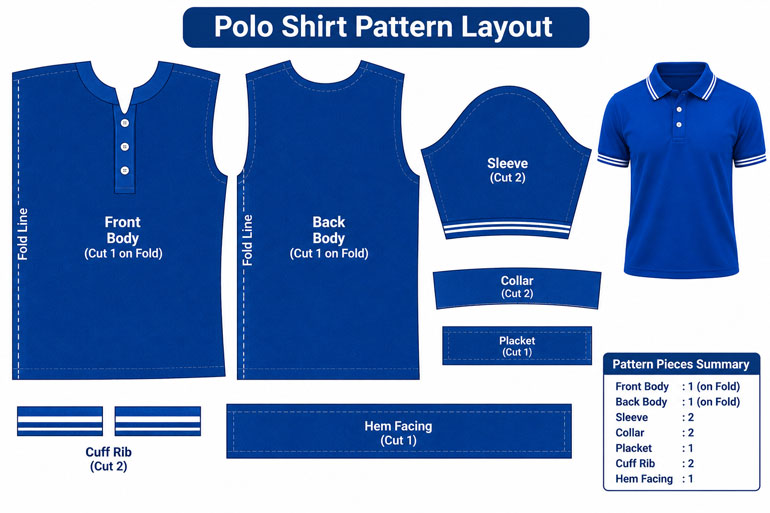
The Formula Behind Body & Sleeve Fabric Estimation
The math is simple. Fabric weight equals area times GSM. Area is measured in square meters. GSM means grams per square meter.
Body fabric
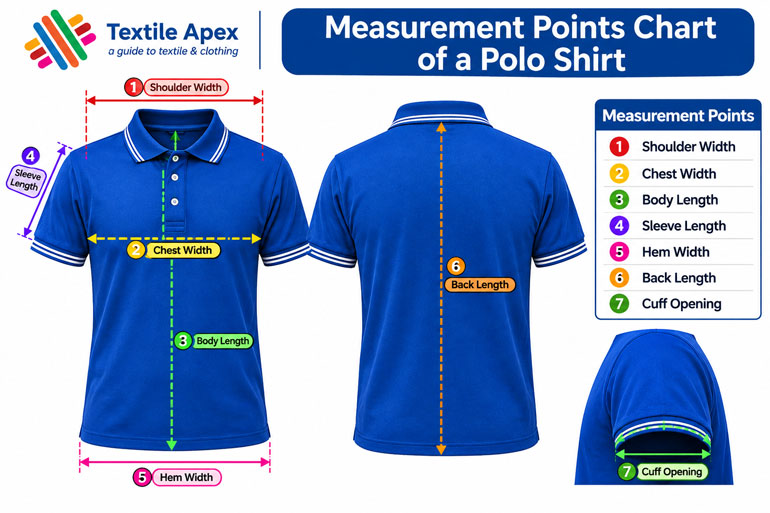
A polo body has a front and a back. So the calculator doubles the area. Body area = length × width × 2. Use half chest width plus side seam allowance.
Sleeve fabric
A polo has two sleeves. Sleeve area = length × average width × 2. Take the average of the bicep and the sleeve opening. This gives a fair estimate.
Core formula
Fabric (kg) = Total area (cm²) × GSM ÷ 10,000 ÷ 1,000 × (1 + wastage ÷ 100). Multiply by 12 for one dozen.
Calculating Collar and Cuff Flat Knit Rib Requirements
Collars and cuffs use flat knit rib. It is a different fabric from the body. It has its own weight and its own price. Never mix the two.
Enter the cut size of the rib. That means the flat length and width before folding. If your polo has cuffs, add them to the collar length. A folded collar uses double width, so enter the full cut width.
The placket is usually cut from the body fabric. Some factories use a self-fabric placket. Others use a contrast fabric. Enter its length and width here. The calculator counts it once.
Tip: rib fabric is often ordered by piece or by yarn-dyed lot. Use this result as a base figure. Then ask your rib supplier for their own consumption chart.
Standard Measurement Inputs & Allowances for Accurate Booking
Good inputs give good results. Measure the finished pattern, not the finished garment. Then add allowances.
Sewing allowance
Add 1 cm to 1.5 cm on each seam. Add more for hems. Shoulder, side and armhole seams all need it. Skipping this step is a common mistake.
Width and length
Use half chest for body width. Add the allowance on both sides. For length, measure from high point shoulder to the hem. Add the hem allowance too.
Marker efficiency
Real cutting never uses 100% of the fabric. Gaps appear between pieces. That loss goes into your wastage percentage. Do not enter it twice.
Why Accounting for Fabric GSM and Wastage is Critical
GSM sets the weight of every square meter. A 180 GSM fabric is lighter than a 220 GSM fabric. The same polo needs more kilograms in the heavier one. A small GSM change affects the whole order.
Wastage covers cutting loss, defects, shrinkage and end-of-roll waste. Most polo orders use 5% to 10%. Solid colors sit near the low end. Stripes and prints sit near the high end.
Under-booking is costly. You run short and face a re-dye. Shade may not match. Delivery slips. Over-booking is costly too. It ties up cash in dead stock.
Use this calculator early. Use it at costing, and again at booking. Then compare it with your actual cutting report. Over time, you will build your own accurate wastage numbers.
Frequently Asked Questions
Most factories use 5% to 10%. Solid colors need less. Stripes, prints and engineered designs need more.
They are different fabrics. Each has its own GSM, yarn and price. Separate booking avoids shortages and costing errors.
GSM means grams per square meter. Higher GSM means heavier fabric. So the same garment uses more kilograms.
Add about 1 cm to 1.5 cm per seam. Add 2 cm to 3 cm for the bottom hem and sleeve hem.
Yards = (kg × 1000) ÷ (GSM × fabric width in meters × 0.9144). Fabric width is the open or tubular cuttable width.
You also like Basic T-shirt Consumption Calculator