Last updated on September 24th, 2023 at 01:27 pm
During spinning operation the drafted strand of fibre being delivered and held at one end by the front rollers, the other end rotates round the bobbin with the traveller on the ring. It is observed that the thread between the thread guide and the traveller, is bulged out which is called the ballooning effect if the thread; and the balloon runs around the bobbin at a high speed equal to the speed of the traveller.
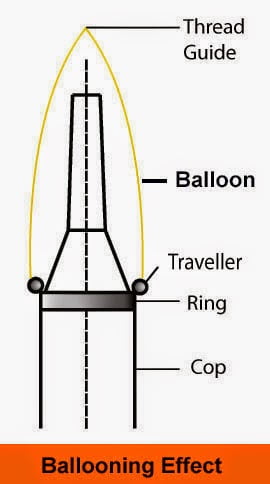
The following factors effect the degree of ballooning:
- The weight of the balloon length – The length of the yarn which shows the ballooning effect is called the balloon length. The degree of ballooning varies inversely as the wt. of the balloon length i.e. higher the balloon length-weight, smaller the balloon size.
- Yarn count – The degree of ballooning varies directly with the yarn count i.e. higher the yarn count, lighter the yarn and higher the balloon size.
- Speed of the traveller – Higher the speed of the traveller, larger the balloon size.
- Weight of the traveller – Lighter the traveller, larger the balloon.
- Atmospheric resistance surrounding it – Higher the resistance, smaller the balloon.
- Frictional resistance at the thread guide and at the traveller against the passage of the thread – Higher this resistance, smaller the balloon size.
The effect of item no. 5 and 6 is little on ballooning. The following measures may be taken to control the ballooning –
- The use of correct traveller size.
- The use of correct traveller speed.
- The use of separator or balloon guards between the two rings.
- By lowering the thread-guide rail to the correct position.
You may also like: The causes of end down in ring spinning