
This free calculator estimates how much fabric one woven shirt needs. It works part by part, adds wastage, and scales the result to your order. Enter the part sizes, then your fabric and order details. Press Calculate to see the answer in yards and meters.
| Part | Pieces | Yards | Meters |
|---|
This is a planning estimate. Confirm with a real marker before you place a bulk fabric order.
How to Use the Woven Shirt Fabric Consumption Calculator
This calculator works part by part. It sizes each shirt piece, adds them up, and applies wastage. You get the answer in yards and meters.
Step-by-Step Guide
- Pick your unit. Choose inch or centimeter.
- Enter the fabric width. The default is 44 inch.
- Set the wastage percentage. The default is 5%.
- Enter the order quantity. Count it as pieces or dozens.
- Check each part size. The defaults suit a standard men’s shirt.
- Press Calculate and read the results.
- Use Copy Result or Share Result to send the figures.
Understanding the Part Sizes
Length
This is the longest side of the cut piece. Include seam allowance.
Width
This is the shorter side of the cut piece. Include seam allowance here too.
Pieces
The piece count is built in. A shirt has two sleeves, so the sleeve count is 2. You cannot edit it. This keeps every calculation consistent.
Inches and Centimeters
Choose centimeters and the calculator converts every size to inches first. The formula always runs in inches. Results show in yards and meters. One yard equals 0.9144 meters.
The Core Formula for Woven Shirt Fabric Consumption
Each shirt part is a small rectangle. Multiply its length by its width. Multiply again by the number of pieces. Then divide by the fabric width and 36. The answer is in yards.
Worked Example
Take 44 inch fabric and 5% wastage. These are the part results in yards:
- Collar (20.25 × 3.75, ×2): 0.096
- Collar band (19 × 2.5, ×2): 0.060
- Yoke (25 × 6, ×2): 0.189
- Back (31.5 × 25, ×1): 0.497
- Front (33 × 28, ×1): 0.583
- Sleeve (24 × 18.25, ×2): 0.553
- Cuff (11.5 × 3.5, ×4): 0.102
- Pocket (8.5 × 6.5, ×1): 0.035
The total is about 2.115 yd per shirt. Add 5% wastage and you get about 2.221 yd. That is roughly 2.031 m.
Why This Method Works
It is quick. It needs no marker software. Merchandisers use it for early costing and quotes. For final orders, a CAD marker gives a tighter figure.
Key Factors That Affect Shirt Fabric Yield
Two shirts with the same size can use different amounts of fabric. Several things change the result.
Fabric Width
Wider fabric means less length per shirt. A 58 inch fabric uses less length than a 44 inch fabric. Always use the cuttable width. Remove the selvedge and any printed edge.
Pattern and Print Matching
Stripes, checks and prints need matching. Matching leaves gaps between pieces. That raises waste. Raise your wastage percentage for these fabrics.
Size and Fit
Bigger sizes use more fabric. Slim fits use less than regular fits. Update the part sizes for each size you plan to cut.
Marker Efficiency
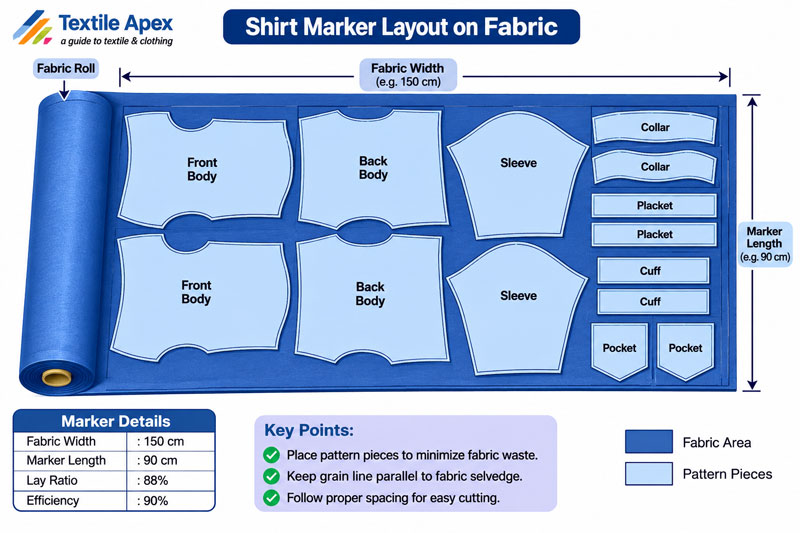
Marker efficiency shows how well pieces fit on the fabric. A good marker reaches 85% to 92%. A poor marker wastes more cloth. Wastage covers that gap.
Style Details
Collar and cuffs
These need several small pieces and interlining. They add small but real consumption.
Pockets and yokes
A chest pocket or a split yoke changes the part list. Adjust the sizes to match your style.
Standard Fabric Allowances for Different Shirt Components
Allowances cover seams, hems and folds. Factories use common ranges. Use them as a starting point. Your buyer’s spec always comes first.
| Component | Typical allowance |
|---|---|
| Side seam and shoulder seam | 1.0 to 1.5 cm |
| Armhole and sleeve seam | 1.0 cm |
| Bottom hem | 1.0 to 1.5 cm |
| Collar and collar band | 0.7 to 1.0 cm |
| Cuff | 0.7 to 1.0 cm |
| 1.0 cm seam, 2.5 cm top fold | |
| Cutting and shrinkage loss | 3% to 7% |
Seam and Hem Allowances
These are small. They add up across a shirt. Every panel has several edges. Each edge needs a margin.
Shrinkage Allowance
Woven cotton can shrink 1% to 3% after washing. Add this to your wastage. Check the mill’s test report for the real figure.
Cutting Loss
Fabric ends, defects and table splices all create loss. Tight spreading reduces it. Good planning keeps it near 3%.
Why Accurate Fabric Consumption Matters for Garment Manufacturers
Fabric is the biggest cost in a shirt. It often makes up half of the total cost. A small error across thousands of pieces becomes a large loss.
Better Cost Control
Accurate figures give accurate quotes. If you under-estimate, you lose margin. If you over-estimate, you may lose the order.
Smarter Purchasing
Correct numbers help you book the right fabric quantity. You avoid short orders and costly reorders. You also avoid dead stock.
Less Waste
Less excess fabric means less waste in landfill. It also saves water, energy and money. Many buyers now ask for these figures.
Stronger Buyer Trust
Buyers value clear, repeatable costing. A consistent method shows you know your product. It builds long-term relationships.
Use this calculator for quick checks. Then confirm the figure with a CAD marker before cutting.
Frequently Asked Questions
What is the standard formula used to calculate woven shirt fabric consumption?
For each part: length × width × pieces ÷ (fabric width × 36), in inches. Add all parts, then add wastage.
How much fabric wastage should I account for in woven shirts?
Most factories use 3% to 7% for solid fabrics. Use more for stripes, checks and prints that need matching.
Does fabric width change the total consumption calculation?
Yes. Wider fabric needs less length for the same shirt. Always use the cuttable width, not the full roll width.
How do I calculate fabric consumption for different shirt sizes?
Change the part sizes to match each size and calculate again. Then average the results by the size ratio of your order.
What parts of a woven shirt consume the most fabric?
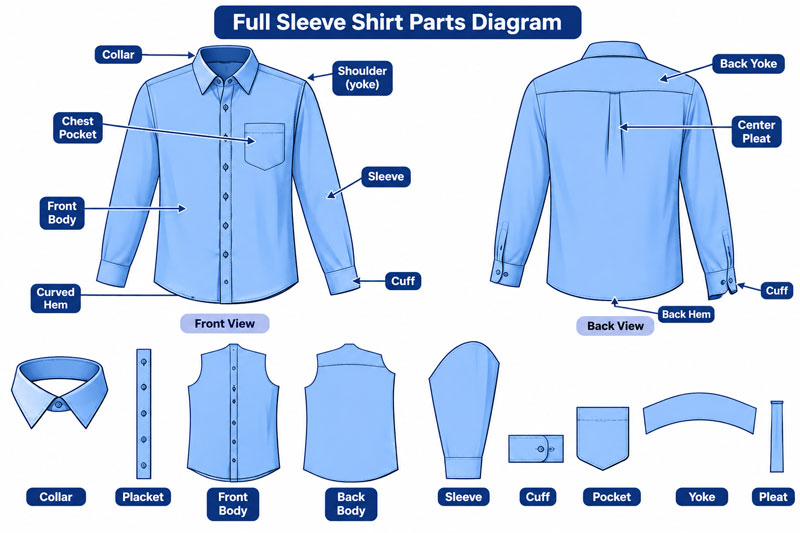
The front and back panels use the most. The two sleeves come next. Collar, band, yoke, cuffs and pocket use the rest.
You also like: Fabric Consumption Per Dozen of a Shirt


