
Last updated on November 26th, 2026 at 06:28 pm
Convert any yarn count between Tex, Denier, Ne and Nm. Enter your value, choose the system you have, and press Calculate. All four equivalents appear at once.
Enter a yarn count greater than zero.
What is Yarn Count Conversion?
Yarn count tells you how fine or thick a yarn is. A fine yarn has a small diameter. A coarse yarn has a large one. Mills around the world use different systems to describe this. So one yarn can have four different numbers.
Yarn count conversion changes a value from one system to another. For example, a 30 Ne cotton yarn equals about 19.68 Tex. It also equals 177.16 Denier and 50.80 Nm.
You need this when you buy yarn from another country. You also need it when you read a spec sheet, compare suppliers, or plan a fabric. This calculator does the work in one click.
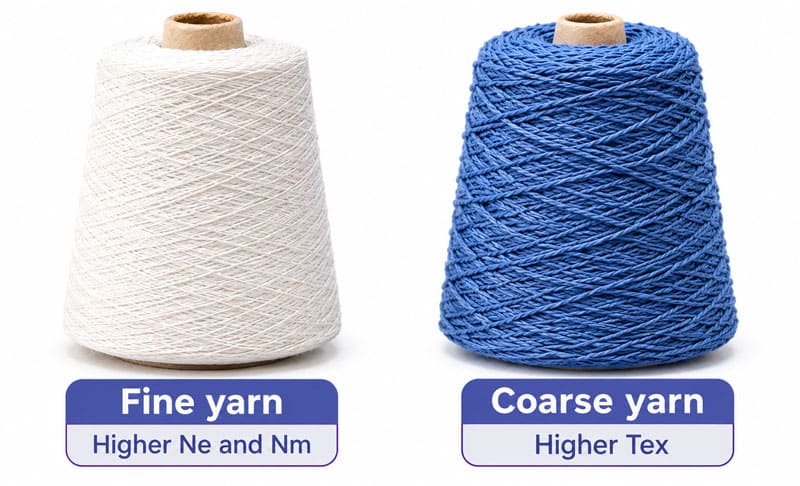
There are two families of count systems. Direct systems measure weight per fixed length. Tex and Denier are direct. A bigger number means a thicker yarn. Indirect systems measure length per fixed weight. Ne and Nm are indirect. A bigger number means a finer yarn.
How to Use the Calculator
The calculator is simple. It takes under ten seconds.
- Type your yarn count in the value box.
- Pick the system you already have: Tex, Denier, Ne or Nm.
- Press Calculate.
- Read all four equivalents in the result.
You do not need to choose a target system. The result shows every system at once. Press Copy Result to save the numbers. Press Share Result to send them to a colleague. Press Reset to start again.
The value must be greater than zero. If the box is empty or shows 0, you will see a short warning.
The Formula
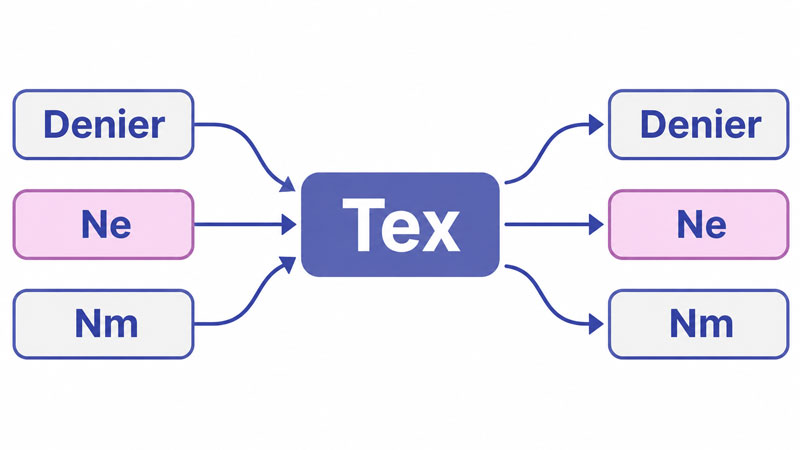
All conversions go through Tex. Tex is the common middle step. First convert your value to Tex. Then convert Tex to the other systems.
Step 1: Convert to Tex
From Denier
Tex = Denier ÷ 9
From Ne
Tex = 590.541 ÷ Ne
From Nm
Tex = 1000 ÷ Nm
Step 2: Convert from Tex
Denier = Tex × 9
Ne = 590.541 ÷ Tex
Nm = 1000 ÷ Tex
If your value is already in Tex, skip Step 1. The calculator keeps full precision inside and rounds only the final answer to two decimals.
Worked Examples
Example 1: 20 Tex
Denier = 20 × 9 = 180.00. Ne = 590.541 ÷ 20 = 29.53. Nm = 1000 ÷ 20 = 50.00.
Result: 20 Tex = 180.00 Denier = 29.53 Ne = 50.00 Nm.
Example 2: 30 Ne
Tex = 590.541 ÷ 30 = 19.68. Denier = 19.68 × 9 = 177.16. Nm = 1000 ÷ 19.68 = 50.80.
Result: 30 Ne = 19.68 Tex = 177.16 Denier = 50.80 Nm.
Example 3: 150 Denier
Tex = 150 ÷ 9 = 16.67. Ne = 590.541 ÷ 16.67 = 35.43. Nm = 1000 ÷ 16.67 = 60.00.
Result: 150 Denier = 16.67 Tex = 35.43 Ne = 60.00 Nm.
Yarn Count Conversion Table
Use this table for quick checks. Values start from Tex and are rounded to two decimals.
| Tex | Denier | Ne | Nm |
|---|---|---|---|
| 10 | 90.00 | 59.05 | 100.00 |
| 15 | 135.00 | 39.37 | 66.67 |
| 20 | 180.00 | 29.53 | 50.00 |
| 25 | 225.00 | 23.62 | 40.00 |
| 30 | 270.00 | 19.68 | 33.33 |
| 40 | 360.00 | 14.76 | 25.00 |
| 50 | 450.00 | 11.81 | 20.00 |
| 60 | 540.00 | 9.84 | 16.67 |
| 100 | 900.00 | 5.91 | 10.00 |
Notice the pattern. As Tex goes up, Ne and Nm go down. That is the direct and indirect split at work.
Yarn count also feeds into fabric planning. After converting, you can check thread density with the EPI/PPI & Cover Factor Calculator. For knitted goods, try the Knit Fabric GSM Calculator. To estimate price, use the Fabric Costing Calculator.
Common Mistakes
- Mixing direct and indirect systems. A higher Tex means thicker yarn. A higher Ne means thinner yarn. Do not compare them directly.
- Using the wrong constant. Ne needs 590.541. Using 590 or 600 adds small errors that grow in bulk orders.
- Confusing Ne with Nm. They are not the same. 30 Ne is about 50.80 Nm.
- Rounding too early. Round only at the end. Early rounding shifts the final numbers.
- Ignoring ply. A 2/30 Ne yarn is two strands of 30 Ne. Its resultant count is about 15 Ne. Convert the right number.
- Typing zero or a negative value. A count must be above zero.
When in doubt, check one result by hand with the formulas above.
FAQs of Yarn Count Conversion Calculator
Tex is the weight in grams of 1,000 metres of yarn.
Denier is the weight in grams of 9,000 metres of yarn. It is common for filament yarns.
Ne counts 840-yard hanks per pound. Nm counts kilometres per kilogram.
Tex links all systems with simple formulas. It keeps the math consistent.
Finer. Ne is an indirect system, so a higher number means a thinner yarn.
Yes. Enter any value greater than zero, such as 24.5.