
Enter your knit data. Pick any unit you like. The tool converts everything for you.
What is Knit Fabric GSM and Why Does It Matter?
GSM means grams per square metre. It tells you how heavy one square metre of fabric is. Simple as that.
In knitting, GSM is the first number buyers ask for. It shapes how a fabric feels, drapes and wears. A 120 GSM jersey feels light and airy. A 300 GSM fleece feels thick and warm.
GSM also drives cost. Heavier fabric uses more yarn. More yarn means a higher price per metre. So a small GSM error can hurt your margin fast.
Mills, merchandisers and buyers all use it. Everyone speaks the same language. That is why a quick, reliable GSM calculator saves real time.

How to Calculate GSM Using a Physical Fabric Sample
This is the classic method. It needs a sample and a scale. It also gives you the actual weight, not a prediction.
What you need
- A GSM round cutter (100 cm²) or a sharp knife and a ruler
- A digital scale with 0.01 g accuracy
- A fabric piece that is relaxed and free of wrinkles
Steps to follow
- Condition the fabric. Leave it flat for 24 hours at standard room conditions.
- Cut a 100 cm² circle. Stay away from the selvedge and any folds.
- Weigh the sample in grams.
- Multiply the weight by 100.
Example: a 100 cm² piece weighs 1.65 g. So the fabric is 165 GSM.
Quick tip
Take three samples from different spots. Then average them. One sample can mislead you.
The Theoretical GSM Formula for Knitting Production
You do not always have a sample. Sometimes you are planning a new fabric. Then you can predict GSM from the machine settings.
Here is how the parts fit together.
- Courses/cm × Wales/cm gives the number of loops in one square centimetre.
- Stitch length is the yarn used in one loop.
- Tex converts that yarn length into weight.
Worked example
Take 18 courses/cm, 14 wales/cm, a 2.8 mm stitch length and 30s Ne cotton (19.68 Tex). That gives 18 × 14 × 2.8 × 19.68 ÷ 100 = about 139 GSM.
Reading the loop length insight
Stitch length is also called loop length. It controls the whole fabric. A longer loop makes the fabric lighter, looser and more stretchy. A shorter loop makes it denser, firmer and heavier.
The calculator also shows a tightness factor (K). It is the square root of Tex divided by loop length in mm. A low K means an open, loose structure. A high K means a tight, compact one. For single jersey cotton, a K near 1.4 to 1.7 is a common balanced range.
Converting Yarn Count (Ne) to Tex for Knit Calculations
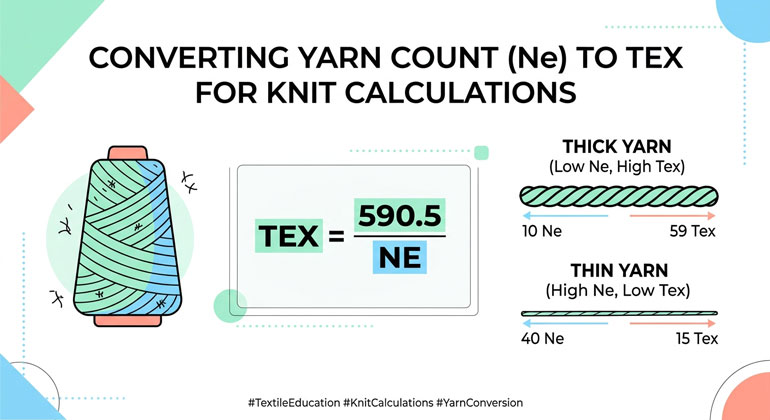
Yarn count comes in many systems. Cotton spinners use Ne. Filament makers use Denier. The formula above needs Tex. So you convert first.
The tool does this for you. Still, these quick rules help you check numbers by hand.
- Tex = 590.5 ÷ Ne
- Tex = 1000 ÷ Nm
- Tex = Denier ÷ 9
- Tex = Dtex ÷ 10
Remember one thing. Higher Ne means finer yarn. Higher Tex means thicker yarn. They move in opposite directions. So 20s Ne (29.5 Tex) is thicker than 40s Ne (14.8 Tex).
Standard GSM Reference Chart for Popular Knit Fabrics
Use this chart as a starting point. Real values change with yarn, finish and machine gauge.
| Fabric | Typical GSM | Common use |
|---|---|---|
| Single jersey (light) | 110 – 140 | Summer tees, innerwear |
| Single jersey (standard) | 140 – 180 | Everyday T-shirts |
| Pique | 180 – 230 | Polo shirts |
| 1×1 Rib | 160 – 220 | Neckbands, fitted tops |
| Interlock | 180 – 240 | Premium tees, kidswear |
| French terry | 220 – 300 | Hoodies, joggers |
| Fleece | 240 – 340 | Winter sweatshirts |
Compare your result with this table. If it falls far outside the range, check your inputs. Then review your stitch length.
Frequently Asked Questions
Both measure fabric weight. GSM uses grams per square metre. Oz/Yd² uses ounces per square yard. Multiply Oz/Yd² by 33.9 to get GSM.
Relaxation, shrinkage, dyeing and finishing change the fabric. Counting errors and yarn variation also add a gap. A difference of 3 to 5 percent is normal.
Longer stitches use more yarn per loop, but they also lower the loop density. Overall, a longer stitch gives a looser, lighter fabric. A shorter stitch gives a denser, heavier one.
Yes. Count courses and wales per cm. Measure the stitch length. Then use this calculator with your yarn count. It predicts GSM without any weighing.
Most premium tees sit between 180 and 220 GSM. Single jersey around 160 to 180 GSM feels soft but still holds its shape.
You also like: Ounce to GSM Calculator