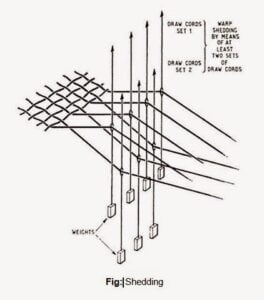
Planning a warp starts with numbers. Use the Warp Yarn Requirement Calculator to find your warp and weft cover factors and total cloth cover. It also estimates the warp yarn you need to buy. Enter your fabric details below. Pick the units that suit you.
Formula: Kc = K1 + K2 − (K1 × K2 ÷ 28). Cover factor = threads per inch ÷ √Ne.
Project Dimensions & Loom Setup
Start with the finished cloth. Decide the width and the length you want. Write both down in one unit. The calculator converts the rest for you.
Next, check your loom. The reed width limits your cloth width. The reed dent count sets your possible EPI. Know these limits before you buy yarn.
Now pick your yarn counts. Warp and weft can differ. Finer yarn gives a lighter cloth. Coarser yarn gives a heavier one. Use Ne, Tex, Denier or Nm. The tool handles each system.
Estimating Loom Waste & Shrinkage Allowances
Every warp loses some length. You cannot weave the last few inches. Knots, tie-ons and tension adjustments eat more.
Loom waste
Loom waste covers the unwoven ends of the warp. It is often a fixed length, not a percentage. For short warps, waste matters a lot. For long warps, it matters less. A range of 3% to 8% suits most projects.
Shrinkage and take-up
Take-up happens as threads go over and under each other. This crimp makes the yarn longer than the cloth. Washing then shrinks the cloth further. Cotton may shrink 5% to 10%. Wool may shrink more. Test a small sample first. Measure it before and after washing.
Quick tip
When unsure, round your allowance up. Extra yarn is cheap. A short warp is not.
Calculating Total Warp Ends & Project Length
Total warp ends equal EPI times width in inches. A 58 inch cloth at 60 EPI needs 3,480 ends. Selvedge threads add a few more. Add them if you use extra ends.
Warp length needs more care. Start with the finished length. Divide it by one minus the shrinkage rate. This gives the length you must weave. Then add loom waste on top. The result is the length of each warp end.
Why cover factor matters
Cover factor tells you how tightly the threads pack. Warp cover factor is EPI divided by the square root of Ne. Weft cover factor uses PPI. Total cloth cover combines both. It also corrects for overlap between the threads.
A low value gives an open, light cloth. A high value gives a dense, firm cloth. Most plain fabrics fall between 14 and 24.
Total Warp Yardage & Weight Formulas
Total warp yarn is simple. Multiply total ends by the length of each end. This gives total yards or meters.
Weight comes next. In English count, use this formula:
Weight (lb) = Total yards ÷ (840 × Ne)
Divide by 2.2046 to get kilograms. Buyers often order yarn by weight. So this number is very useful.
For Tex, the formula changes. Weight in grams equals Tex times length in meters, divided by 1,000. The calculator converts all counts to Ne first. This keeps results consistent.
Always add a small safety margin. Five percent more is a sensible buffer. Yarn lots can vary in shade between orders. Buy it all at once.
Converting Yarn Requirements by Count and Color
Many warps use more than one color. The method is easy. Count the ends in each color stripe. Multiply by the length of each end. Then convert each color to weight.
Say your pattern repeats every 20 ends. Twelve are navy and eight are cream. Divide total ends by 20 to get the repeats. Multiply by 12 for navy ends. Multiply by 8 for cream ends. Run each total through the formula.
Different counts in one warp need the same step. Calculate each count on its own. Never average two counts. The numbers will be wrong.
Finally, add the color weights together. The sum should match your total warp weight. If it does not, recheck your ends per color.
Frequently Asked Questions
What happens if I miscalculate my Ends Per Inch (EPI)?
Too few ends make a loose, weak cloth. Too many make it stiff and hard to weave. Your yarn order will also be wrong. Test a sample before the full warp.
How do I know how much loom waste to factor in?
Check your loom. Measure the length you cannot weave at both ends. Add it to your warp. If unsure, use 3% to 8% of the warp length.
Why does my project shrink so much after washing?
Yarn relaxes in water. Fibers swell and threads pull closer. Natural fibers like cotton and wool shrink the most. Wash a sample first to measure it.
How do I calculate warp yarn if I am using multiple colors?
Count the ends in each color. Multiply by the end length. Convert each color to weight. Then add them up.
Can I use the same weight calculation for both warp and weft?
Yes, the formula is the same. Only the length differs. Weft length per pick equals fabric width plus allowance. Multiply it by total picks.
You also like: What is Weaving | A Short History of Weaving