
Free EPI/PPI and Fabric Cover Factor Calculator
Enter your ends and picks per inch (or per cm) and your yarn counts. Pick a unit for each value. You get warp, weft and total cloth cover factors.
Formulas: K1 = EPI ÷ √Ne, K2 = PPI ÷ √Ne, K = K1 + K2 − (K1 × K2) ÷ 28. Tex, Denier and Nm are converted to Ne first. The constant 28 comes from the cotton system.
What is Fabric Cover Factor and Why Does It Matter?
Fabric cover factor shows how tightly yarns are packed in a woven cloth. It compares the number of yarns per inch with the thickness of those yarns. A high number means a dense, closed fabric. A low number means an open one.
Think of it as a fill level. At zero, the fabric is empty space. At the theoretical maximum, the yarns touch each other and nothing more can fit.
Why mills and designers track it
Cover factor predicts how a fabric will behave. It links the numbers on your loom card to the feel of the finished cloth. Here is what it tells you:
- How much light and air pass through the cloth.
- How stiff, soft or drapey the fabric will feel.
- How well it resists wind, water and abrasion.
- How much it weighs and what it costs to weave.
It also helps you compare designs fairly. Two fabrics can share the same EPI and PPI. But if one uses finer yarn, its cover is lower. Cover factor puts them on the same scale.
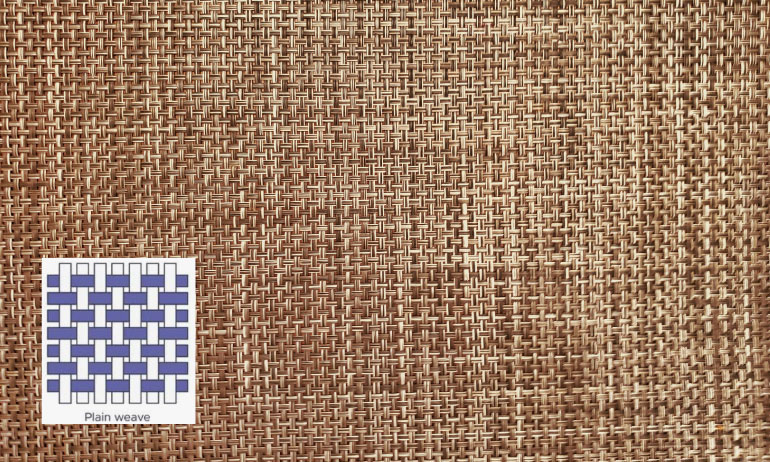
Key Variables Explained: Understanding EPI, PPI, and Yarn Count
Three inputs drive the whole calculation. Get these right and the result follows.
EPI and PPI
EPI means ends per inch. Ends are the warp yarns that run along the fabric length. PPI means picks per inch. Picks are the weft yarns that run across the width.
Count them with a pick glass. Place it on the fabric. Count the yarns inside the one-inch window. Repeat in several spots and take the average.
Many countries use yarns per centimeter. This calculator accepts both. It converts per-cm values to per-inch by multiplying by 2.54.
Yarn count systems
Yarn count tells you how fine or coarse a yarn is. Different systems use different logic.
Indirect systems: higher number, finer yarn
Ne (English cotton count) and Nm (metric count) are indirect. A 60s Ne yarn is finer than a 20s Ne yarn.
Direct systems: higher number, coarser yarn
Tex and Denier are direct. Tex is the weight in grams of 1,000 meters of yarn. Denier is the weight in grams of 9,000 meters. A 40 Tex yarn is coarser than a 20 Tex yarn.
Conversions used here
- Ne = 590.54 ÷ Tex
- Ne = 5315 ÷ Denier
- Ne = 0.5905 × Nm
Step-by-Step Guide: How to Calculate Warp and Weft Cover Factors
You can use the calculator above. But it helps to know the math behind it. The method comes from Peirce’s classic fabric geometry work.
Step 1: Convert everything to Ne
If your yarn is in Tex, Denier or Nm, convert it to Ne first. Use the formulas above. If your density is per cm, convert it to per inch.
Step 2: Find the warp and weft cover factors
Divide each density by the square root of its yarn count.
- Warp cover factor K1 = EPI ÷ √Ne (warp)
- Weft cover factor K2 = PPI ÷ √Ne (weft)
Step 3: Combine them into a total
The two sets of yarns overlap each other. So you cannot just add K1 and K2. Subtract the overlap:
K = K1 + K2 − (K1 × K2) ÷ 28
A worked example
Take a fabric with 100 EPI, 60 PPI and 40s Ne in both directions. The square root of 40 is 6.32.
- K1 = 100 ÷ 6.32 = 15.81
- K2 = 60 ÷ 6.32 = 9.49
- K = 15.81 + 9.49 − (15.81 × 9.49 ÷ 28) = 19.94
Divide 19.94 by 28 and you get 0.71. So this fabric covers about 71% of its area.
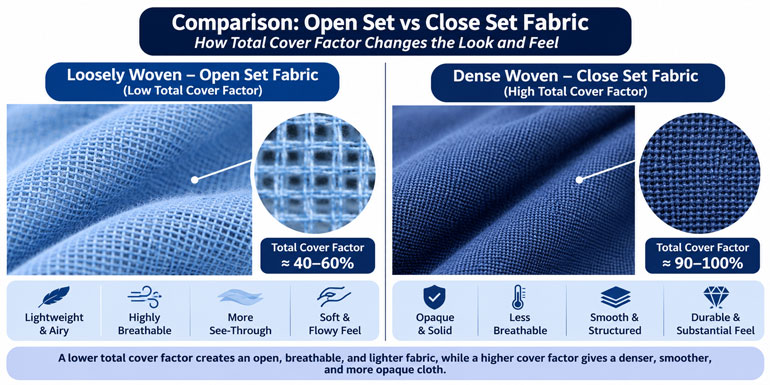
Deciphering the Results: Open Set vs. Close Set Fabrics
Now you have a number. What does it mean? Use these ranges as a general guide. They are rules of thumb, not strict standards. End use always matters.
- Below 14: very open, sheer fabrics such as voile or gauze.
- 14 to 19: semi-open fabrics with a light, airy hand.
- 19 to 24: medium to firm fabrics, common in shirting and sheeting.
- 24 to 28: closely set fabrics such as canvas, duck and poplin for outerwear.
- Above 28: over-packed. The yarns are crowded beyond the ideal limit.
Open set fabrics
Open set cloths have visible gaps between yarns. They breathe well and feel soft. They also shift more and show more seam slippage. They suit summer wear, curtains and filter cloths.
Close set fabrics
Close set cloths have little or no gap. They block wind and resist wear. They can feel stiff and are harder to weave. They suit workwear, tents and upholstery.
Balance matters too
Compare K1 and K2. A large gap means the cloth is warp-dominant or weft-dominant. That affects strength, shrinkage and surface look. Many fabrics are made this way on purpose, such as rib weaves.
Troubleshooting Common Fabric Cover Factor Variations
Sometimes the calculated number does not match the cloth in your hand. Do not panic. Check the usual suspects first.
Counting errors
Miscounting EPI or PPI by a few yarns shifts the result a lot. Count in at least three places. Avoid areas near the selvedge. Make sure the fabric is relaxed and not stretched.
Greige versus finished fabric
Fabric shrinks during desizing, washing and finishing. EPI and PPI usually rise as it shrinks. Always state whether your numbers come from greige or finished cloth.
Yarn count variation
The label count is only nominal. Real yarn varies. Blended and slub yarns can differ even more. If possible, test the yarn count from the fabric itself.
Weave structure
The formula assumes plain weave. Twills and satins have fewer interlacings. They can pack more yarns into the same space. So they may show a higher number without being over-packed.
Non-cotton fibers
The constant 28 assumes cotton density. Polyester, nylon and wool have different densities. Treat the result as a useful comparison, not an exact value.
Checklist
- Recount EPI and PPI.
- Check the unit: per inch or per cm.
- Check the count system: Ne, Tex, Denier or Nm.
- Confirm greige or finished state.
- Note the weave and fiber type.
Frequently Asked Questions
There is no single ideal value. Most general-purpose cotton plain weaves sit around 19 to 24. Lighter fabrics go lower. Heavy canvas goes higher, up to about 28.
The formula stays the same. You first convert Tex or Denier to Ne. Use Ne = 590.54 ÷ Tex or Ne = 5315 ÷ Denier. Then apply K = EPI ÷ √Ne.
Cover factor is a dimensionless index that depends on count units. Fractional cover is the share of space one yarn set fills, from 0 to 1. In the cotton system, fractional cover equals cover factor ÷ 28.
Common causes are counting errors, finishing shrinkage, off-nominal yarn counts and non-plain weaves. Fiber type also matters. Recount, confirm the fabric state and check the real yarn count.
For round yarns in plain weave, 28 is the jamming limit. The formula can still return a higher number if one direction is very dense. That signals over-packing or flattened yarns. Floating weaves such as twills and satins can pack more.
You also like Garment Carton CBM Calculator for Export Packing