What is Marker Efficiency Calculator?
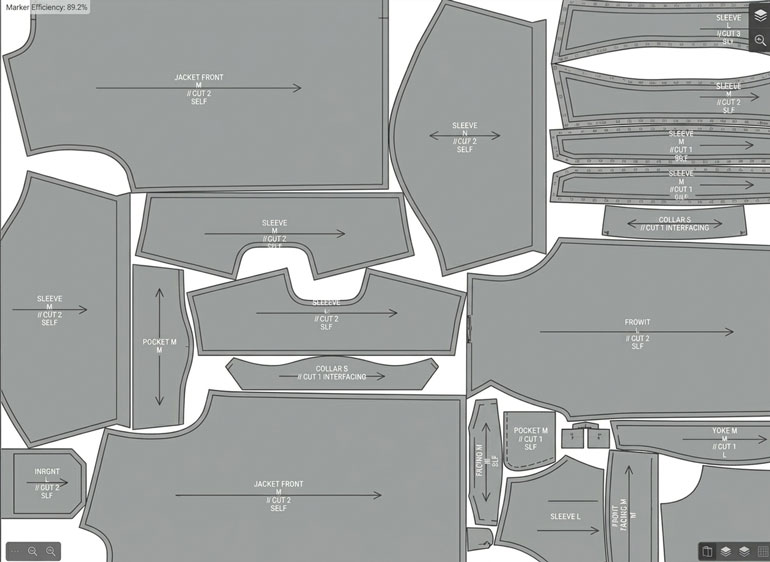
A marker is a layout of pattern pieces. It is placed on fabric before cutting. Marker efficiency tells you how well those pieces fill the layout.
This calculator does the math for you. Enter the marker length and width. Add the total area of your pattern pieces. Then press Calculate. You get the efficiency, the waste and the marker area in seconds.
Fabric is the biggest cost in a garment. A small gain in efficiency saves real money. So checking every marker is a smart habit.
The tool also supports international units. Pick meters, centimeters, inches, feet or yards. Pick the area unit too. You can mix units freely. The calculator converts everything for you.
Marker Efficiency Formula
The formula is simple. It compares used fabric area with total marker area.
Marker Efficiency (%) = (Area of Pattern Pieces ÷ Area of Marker) × 100
Marker Area = Marker Length × Marker Width
Fabric Waste (%) = 100 − Marker Efficiency
A quick example
Say your marker is 5 yards long and 58 inches wide. That is 180 in × 58 in = 10,440 in². Your pattern pieces total 9,000 in². Efficiency is 9,000 ÷ 10,440 × 100 = 86.21%. Waste is 13.79%.
Keep units consistent
Length, width and piece area must use matching bases. Our calculator handles this. It converts all values to one base unit first. Manual math is where most mistakes happen.
Factors Affecting Marker Efficiency
Many things change the final number. Some you control. Some you do not.
Pattern and design factors
- Shape of the pieces. Curved pieces leave more gaps.
- Number of sizes in one marker. Mixed sizes nest better.
- Size of the pieces. Small pieces fill gaps well.
Fabric factors
- Fabric width. A better width can cut waste a lot.
- Stripes, checks and prints. Matching them adds waste.
- Nap or one-way fabric. Pieces must face one direction.
- Shrinkage and defects. Bad areas must be avoided.
Grain line rules
Each piece has a grain line. It must stay parallel to the selvedge. This limits how you can rotate pieces. Tighter rules mean lower efficiency.
Process factors
- Marker maker skill. Experience matters.
- CAD software. Auto-nesting tools often beat manual work.
- Allowances for end loss and spreading edges.
- Buyer rules on tolerances and gaps.
Marker Efficiency Formula in Garment Industry
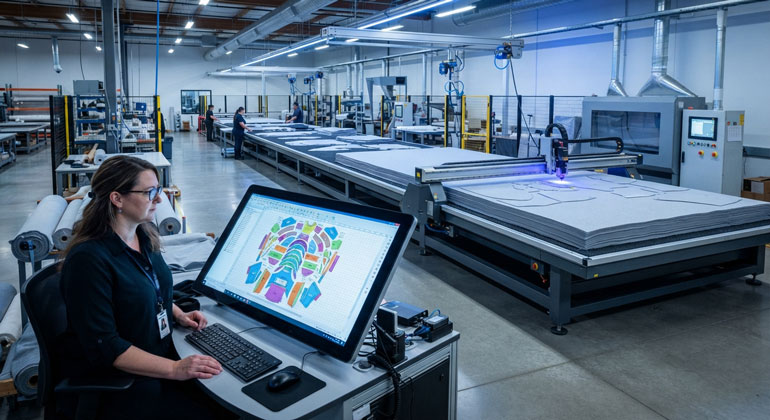
In a real factory, the formula works at a bigger scale. Planners use it to estimate fabric needs and to quote prices.
Typical efficiency ranges
- Basic tees and knit wear: 85% to 92%
- Shirts and trousers: 80% to 88%
- Jackets and complex styles: 75% to 85%
- Stripes and checks: often below 80%
How factories use it
The cutting team makes the marker in CAD. The software shows the efficiency. The planner then compares it with the target. If it is low, the marker maker tries again.
Fabric consumption per garment also depends on this number. Higher efficiency means less fabric per piece. That lowers cost and protects the margin.
Related terms
Fabric utilization is the same idea in another name. Some teams also track marker length, ply height and end loss. Together they give a full picture of cutting performance.
Advantages of Using This Calculator
- Fast. You get results in seconds.
- Accurate. No manual conversion errors.
- International. Works with metric and imperial units.
- Cost saving. Spot weak markers before cutting.
- Easy to share. Copy or share your result with your team.
- Free and simple. No sign-up. Works on any device.
Use it during sampling, costing and planning. Try a few marker versions. Pick the one with the best efficiency. Small gains add up across thousands of garments.
Frequently Asked Questions
How to calculate efficiency in garment industry?
Efficiency (%) = (Output pieces × SAM) ÷ (Operators × Working minutes) × 100. SAM is the standard allowed minute for one piece.
How to calculate line efficiency formula?
Line Efficiency (%) = (Total SAM produced ÷ Total available minutes) × 100. Available minutes = Operators × Working hours × 60.
How to calculate CPM in garment factory?
CPM (cost per minute) = Total factory expenses ÷ Total productive minutes. Productive minutes = Operators × Working minutes × Days × Efficiency.
How to calculate efficiency formula?
Efficiency (%) = (Output ÷ Input) × 100. For a marker, output is the pattern piece area and input is the marker area.
Why does increasing the marker length lower the efficiency percentage?
The piece area stays the same, but the marker area grows. The extra space adds gaps and end loss. So the ratio drops.
You also like Liquor Ratio (MLR) Calculator