Free Garment FOB Costing Calculator
Use this free tool to build a garment FOB price from fabric, trims, CM and margin. Enter your costs per piece, pick your units and currency, and get a full cost breakdown in seconds.
Your FOB Costing Result
| Cost head | FOB (%) | Value | Converted |
|---|
Estimates only. Confirm final prices with your supplier or buyer.
What Is FOB Price in Garment Costing?
FOB means Free on Board. It is the price a buyer pays for a garment loaded on the ship at the port of origin. The seller covers everything until the goods are on board. After that, the buyer takes the risk and pays for freight, insurance and import duty.
In garment costing, the FOB price is the main number in any buyer and factory talk. It includes fabric, trims, labour, overheads, testing, finance and profit. It does not include sea freight or duty. That is why FOB is the standard way to compare prices from different countries.
How to Use This Garment FOB Costing Calculator
The tool is simple. Follow these steps.
- Pick your costing currency. Choose a second currency if you want an international conversion, then enter the exchange rate.
- Select the fabric unit: kg, meter or yard.
- Enter fabric consumption, price and wastage.
- Fill in trims, freight, value additions, CM, inspection and logistics per piece.
- Add finance, commission and profit as percentages of FOB.
- Press Calculate. The result table appears below.
Use Copy Result to save the breakdown. Use Share Result to send it to a colleague. Press Reset to return to the sample values.
Garment FOB Price Formula and Cost Components
The method has two parts. First you add all the direct costs. Then you add the percentage costs on top of the FOB price.
Direct cost per piece
Fabric cost = consumption × (1 + wastage %) × fabric price. Raw material cost is fabric plus sewing trims, packing trims, subcontract and inbound freight. Add value additions, CM, inspection and logistics to reach the base cost.
Percentage costs
Finance, commission and profit are paid as a share of the selling price. So the formula is:
FOB = Base cost ÷ (1 − finance % − commission % − profit %)
Dividing, rather than multiplying, keeps each percentage true to the final FOB price. That matches the cost sheets buyers use.
Main components
- Fabric: usually 50 to 60 percent of FOB.
- Trims: thread, labels, buttons, zips, polybags and cartons.
- CM: the labour and factory overhead to cut, sew and pack.
- Value additions: print, embroidery and garment wash.
- Commission: the buying house or agent fee.
Worked Example: FOB Costing of a Basic T-Shirt
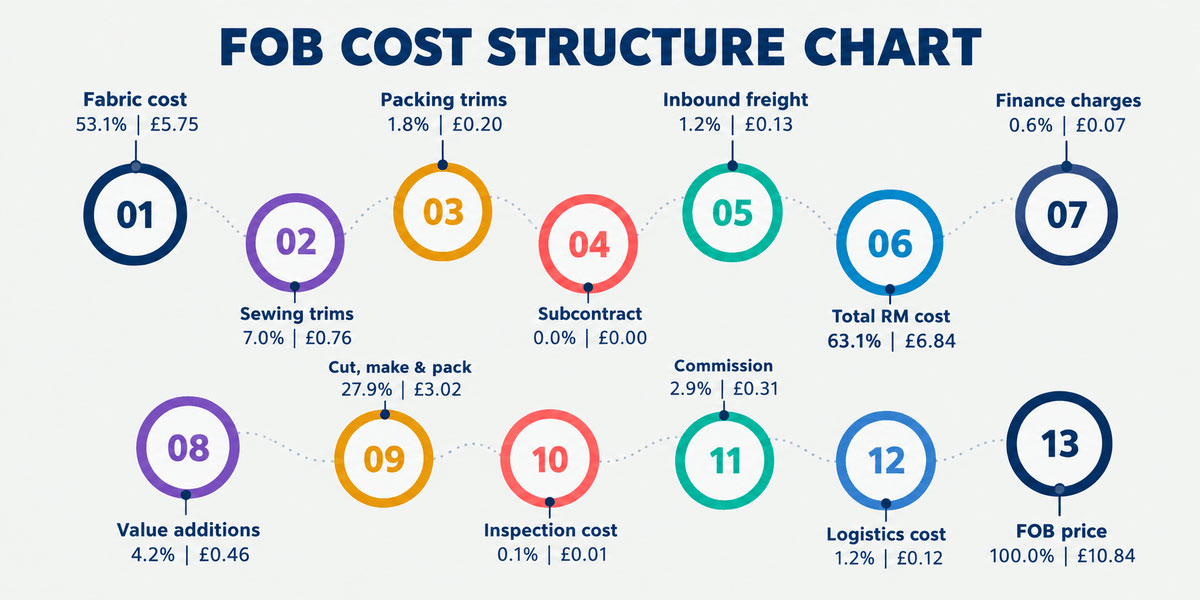
The calculator opens with a sample cost sheet for a basic knit T-shirt. It uses a 0.25 kg fabric consumption at 23.00 per kg. The values are in pounds.
- Fabric: 0.25 × 23.00 = 5.75
- Sewing trims 0.76, packing trims 0.20, inbound freight 0.13
- Raw material cost: 6.84
- Value additions 0.46, CM 3.02, inspection 0.01, logistics 0.12
- Base cost: 10.45
Finance is 0.6 percent and commission is 2.9 percent. That is 3.5 percent in total. So FOB = 10.45 ÷ 0.965 = about 10.83.
Fabric takes just over 53 percent of the price. CM takes about 28 percent. These are normal shares for a basic tee. Try changing the fabric price to see how fast the FOB moves.
Common Garment Costing Mistakes
Small errors can wipe out your margin. Watch for these.
- Ignoring wastage. Cutting waste is real. Add 3 to 8 percent for most knits and wovens.
- Using the wrong unit. Mixing kg, meters and yards ruins the fabric cost. Check the unit twice.
- Forgetting small trims. Hang tags, stickers and tissue paper add up over thousands of pieces.
- Applying commission on cost. Commission is paid on the FOB price, not on cost.
- Using old exchange rates. A weak currency can cut your margin overnight. Update the rate for every quote.
- Skipping rejects and rework. Add an allowance for quality losses.
- Quoting small orders at bulk prices. Setup and fabric minimums cost more per piece on small runs.
Frequently Asked Questions
How to calculate CM?
CM is the cost to cut, make and pack one piece. A common way is SMV × cost per minute, plus overhead. For example, 8 SMV at 0.35 per minute gives 2.80, then add overhead and finishing.
What profit margin do factories use?
Most garment factories add 5 to 15 percent. Basic items and big orders sit at the low end. Fashion items and small orders go higher.
What is the difference between FOB and Landed Cost?
FOB ends when goods are loaded on the ship. Landed cost adds sea freight, insurance, duty, port charges and delivery to the buyer’s warehouse.
Why do small orders increase the FOB price?
Setup, sampling and cutting costs are spread over fewer pieces. Fabric and trim suppliers also add surcharges for low minimums.
How is fabric cost calculated?
Multiply consumption per piece by the fabric price, then add wastage. For example, 0.25 kg × 23.00 = 5.75 before wastage.
You also like the SMV Calculator