Estimate how much yarn your rotor spinning machine produces by using Rotor (Open-End) Spinning Production Calculator. Enter your machine and yarn details. Pick your units. Then press Calculate.
How to Use the Rotor (Open-End) Spinning Production Calculator
Using this tool is quick. You only need six numbers. Keep your machine data nearby.
- Enter the rotor speed and pick rpm or krpm.
- Enter the yarn twist and choose TPI, TPM or TPcm.
- Enter the yarn count in Ne, Tex or Nm.
- Add the number of rotors and the machine efficiency.
- Type the working hours per day.
- Choose the output unit, then press Calculate.
The tool shows delivery speed, yarn tex, and output per rotor. It also shows output per machine, per hour and per day. Press Reset to start again.
Rotor Spinning Production Formula and Calculation Steps
The math is simple. Each step feeds the next one.
Step 1: Delivery speed
Delivery speed in meters per minute equals rotor speed divided by twist per meter. Higher rotor speed gives faster delivery. Higher twist slows it down.
Step 2: Yarn tex
Tex is grams per 1,000 meters. For Ne counts, tex equals 590.54 divided by Ne. For Nm counts, tex equals 1,000 divided by Nm.
Step 3: Output per rotor
Ideal output per rotor per hour in kg equals delivery speed × 60 × tex ÷ 1,000,000. Multiply by efficiency to get the actual output.
Step 4: Machine output
Multiply the actual output per rotor by the number of rotors. Multiply again by the working hours to get daily output. The tool then converts the answer to your chosen unit.
Key Factors Affecting Open-End Spinning Production
Many things change your real output. Some you control. Some you only manage.
Rotor speed
Speed is the biggest lever. Faster rotors deliver more yarn. But very high speed raises ends-down and wear.
Yarn count and twist
Coarse yarn weighs more per meter. So it gives more kilograms per hour. Lower twist also raises delivery speed.
Raw material quality
Clean, even fibre runs smoothly. Trash and short fibre cause breaks. Every break cuts efficiency.
Machine condition and climate
Worn navels, dirty rotors and loose belts hurt output. Stable humidity and temperature help too.
Labour and maintenance
Trained operators fix breaks fast. Planned cleaning prevents sudden stops.
Open-End vs. Ring Spinning Production Rates
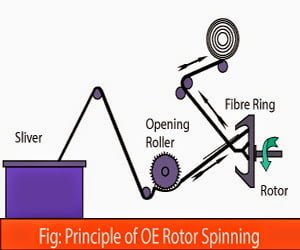
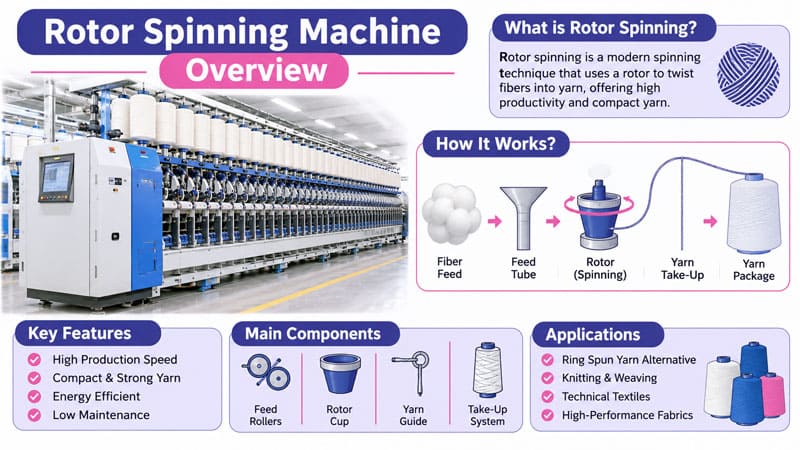
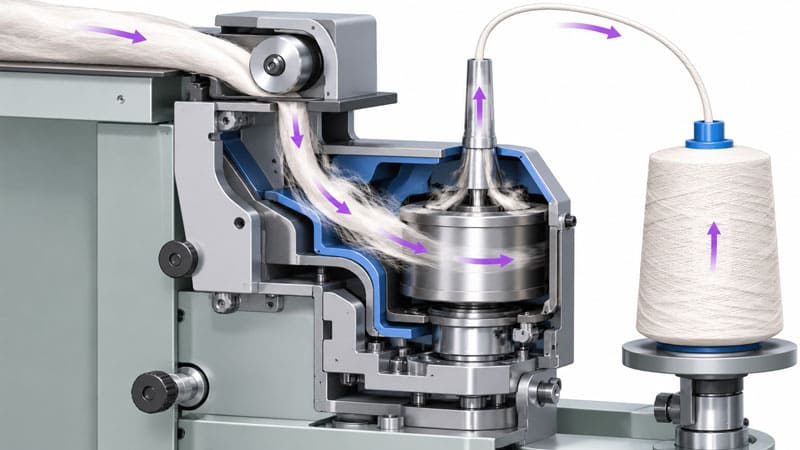
Open-end spinning is much faster than ring spinning. The reason is simple. The rotor spins fibres into yarn without a spindle and traveller.
A ring frame delivers about 15 to 25 meters per minute per spindle. A rotor machine can deliver 100 meters per minute or more per position. That gap is large.
Open-end also skips roving and winding. Fewer steps mean less labour and less handling. Package size is bigger too.
Ring yarn is stronger and finer. Rotor yarn is bulkier, more even and a little weaker. It suits denim, towels, knitwear and home textiles. Ring spinning suits fine, premium yarn.
So pick by product. If you need coarse to medium counts at low cost, rotor spinning wins. If you need strength and softness, ring spinning is better.
Tips to Optimize Rotor Spinning Machine Efficiency
- Clean rotors and navels on a fixed schedule.
- Check opening rollers for wear and damage.
- Match rotor speed to the fibre and count.
- Reduce twist where yarn quality allows.
- Control humidity and keep the air clean.
- Use well-cleaned, even sliver.
- Track ends-down per 1,000 rotor hours.
- Train operators to piece up fast.
- Replace worn parts before they fail.
Small gains add up. One extra point of efficiency across hundreds of rotors saves real money. Run this calculator after each change. Compare the numbers and keep what works.
Frequently Asked Questions
Output per rotor per hour (kg) = (rotor rpm ÷ TPM) × 60 × tex ÷ 1,000,000 × efficiency. Multiply by rotors and hours for total output.
Coarser yarn has a higher tex. It weighs more per meter. So output in kg per hour rises, even if delivery speed stays the same.
Most mills run at about 90 to 95 percent. Well-managed plants can go higher. Poor cotton or weak maintenance lowers it.
The rotor spins at very high speed and needs no spindle or traveller. It also skips roving. This gives much higher delivery speed.
Rotor speed in rpm or krpm. Twist in TPI, TPM or TPcm. Count in Ne, Tex or Nm. Output in kg, lb or tonnes.
You also like: Working Principle of Rotor Spinning