Screen Print Ink Consumption Calculator
Estimate how much ink your screen printing job needs. Enter your print size, quantity, mesh count and ink type. You get the ink per print, the total with waste allowance and an estimated cost. Switch between inches, centimeters and millimeters. View results in grams, kilograms, ounces or pounds.
This is an estimate. Real usage changes with squeegee pressure, ink viscosity and stencil quality.
How to Use the Screen Print Ink Consumption Calculator
This tool gives you a quick ink estimate before you start a job. It takes less than a minute. Follow the steps below.
- Enter the print width and height. Pick inches, centimeters or millimeters.
- Add the number of prints and the number of colors.
- Choose your mesh count and ink type.
- Select the garment color. Dark garments add a white underbase layer.
- Enter the ink coverage. A solid block is 100%. A light logo may be 30% to 50%.
- Add a waste allowance. Ten percent is a safe start.
- Pick your result unit. Add your ink price if you want a cost estimate.
- Press Calculate. Use Copy Result or Share Result to send the numbers.
Key Factors That Affect Screen Printing Ink Usage
Ink use is never fixed. Several small choices add up. Know them and your estimates get sharper.
Mesh Count
Mesh count controls how much ink passes through the screen. A low mesh like 61 lets a thick layer through. A high mesh like 305 lets only a thin film through. Higher mesh means less ink per print.
Ink Type
Plastisol sits on top of the fabric. It is thick, so it uses more ink. Water-based ink soaks into the fibers. It is thinner, so it uses less. Discharge ink is also thin and works best on cotton.
Garment Color
Dark shirts need a white underbase. That is an extra layer of ink. It lifts the colors on top. Expect higher usage on black and navy garments.
Design Coverage and Colors
A big solid design uses more ink than a thin line drawing. Each color is a separate screen. Each screen has its own deposit. Four colors can use four times the ink of one.
Other Small Factors
- Squeegee pressure and angle
- Number of passes per print
- Emulsion thickness on the screen
- Ink viscosity and room temperature
- Fabric texture and absorbency
Screen Print Ink Yield Chart by Mesh Count and Ink Type
This chart shows the average wet ink deposit for a fully covered print. It uses the same values as the calculator. Use it to check your numbers by hand.
| Mesh (T/in) | Plastisol (g/m²) | Plastisol (m²/kg) | Water-based (g/m²) | Water-based (m²/kg) |
|---|---|---|---|---|
| 61 | 100 | 10.0 | 60 | 16.7 |
| 77 | 85 | 11.8 | 51 | 19.6 |
| 110 | 60 | 16.7 | 36 | 27.8 |
| 156 | 42 | 23.8 | 25 | 39.7 |
| 200 | 32 | 31.3 | 19 | 52.1 |
| 230 | 26 | 38.5 | 16 | 64.1 |
| 305 | 18 | 55.6 | 11 | 92.6 |
Values are averages for 100% coverage. Your press and ink may differ. Run a test batch and adjust.
Tips to Reduce Ink Waste and Lower Printing Costs
Ink is one of your biggest running costs. Small habits save real money over time.
Before You Print
- Pick the right mesh for the design. Do not use a low mesh on fine detail.
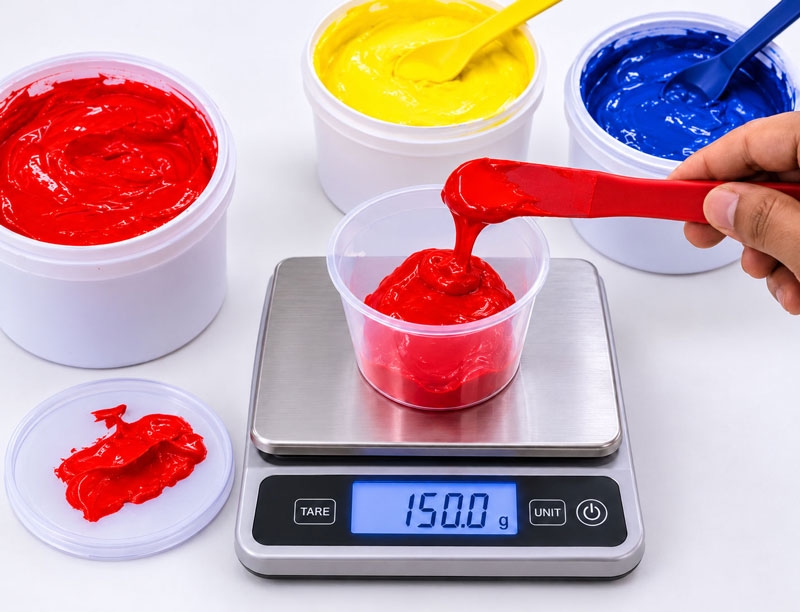
- Weigh your ink. Do not scoop by eye.
- Mix only what the job needs. Leftover custom colors are hard to reuse.
During the Run
- Use steady pressure. Heavy pressure pushes extra ink through.
- Keep one flood stroke and one print stroke when you can.
- Return excess ink from the screen to the container often.
After the Run
Store ink in sealed tubs. Scrape screens well before cleaning. Record the real usage for each job. Compare it with this calculator. Over time, your own data becomes the best guide.
Why Accurate Ink Estimation Matters for Print Shops
Good estimates protect your profit. If you guess too low, you run out mid-job. That means downtime and color mismatch. If you guess too high, cash sits in unused ink.
Accurate numbers also help with quotes. You can price each order with confidence. Customers get fair prices. You keep a healthy margin.
Ordering gets easier too. You know how much to buy each month. You avoid rush orders and shipping fees. Less waste also means less disposal and a cleaner shop.
Finally, estimates help you compare options. You can test plastisol against water-based ink. You can see the cost of a white underbase. Smart choices start with clear numbers.
Frequently Asked Questions
A typical full-chest print uses about 15 to 40 grams of plastisol per color. Water-based ink uses less.
Yes. Low mesh counts deposit more ink. High mesh counts deposit less and suit fine detail.
Yes. Dark garments need a white underbase. That adds one extra ink layer to every print.
Plastisol is thick and sits on the fabric, so it uses more. Water-based ink is thinner and soaks in, so it uses roughly 40% less.
Yes. Add 5% to 15% for screen flooding, test prints and cleanup. Short runs need a higher allowance.
You also like: Different Types of Textile Printing Technique